> He was stranded twenty miles from the nearest settlement, with only enough food and water to last ten days. To survive, Leray used parts of his broken-down car to build a motorcycle, and twelve days after the accident was able to drive it to a village 20 miles away.
I admire his ingenuity, but I would have probably just walked.
In the desert, you often really don't want to be walking midday, but if the moon is out doing 20 miles in a night isn't too bad, and doing it split over two days is fine. 5 or 6 liters of water plus some food would be plenty, depending on what you have available to carry that ~15 pounds splitting into two days may be more comfortable. Either way, infinitely less risky than building a motorcycle.
4 mph takes talent, especially over distance. Andthat’s on hard surfaces. From what I understand walking on sand is deceptively taxing. I’d say 2-2.5 and not as the bird flies distances. So ten to fifteen hours of walking if your feet let you.
The desert in question isn't all sandy dunes; there's a lot of rocky or compacted surface (see photo), so you can make pretty decent time (but yeah, sustaining 4mph would be pushing it for most people).
I've done 97km in 26 hours before, in the Sahara (I think we started around 8am, and finished around 10ish the next morning), which works out to about 2.3mph, so I'd agree 2-2.5mph is reasonable.
hmm, [0] this says the longest stage was 91km in 2009 (I did it in 2015), so I could be wrong, but I'm going by what my garmin told me.
That was my thought as well. He might not have had something to carry the food and water, but making something to carry it would probably be easier than building a motorcycle.
I enjoy the backstory[1], though, about how he ended up that way:
> He was told the area was restricted and he couldn’t go through. Ignoring the request, he instead drove off at top speed into the rocky terrain of the restricted area, making sure the military officials weren’t following him, according to the site.
> Leray told the UK’s Sunday Times that he had travelled around Africa about 10 times so knew the region well. But before long, his he crashed the car into a rock, rendering it unable to drive.
Only if you think his story is true. I'm pretty sure it is more of an art project though. Mostly because from a survival perspective the story makes no sense.
It's a picture of the motorcycle in front of a picture of the guy that made it with the motorcycle off in the distance. So it's not a picture of a motorcycle, it's a picture of a picture. So if you want to show a picture of the motorcycle, removing the background would isolate the motorcycle.
I think he is referring to the fact that the photograph is actually a photo of the real motorcycle with the photo I meant to post behind it, at a museum.
"On display in the Midwest Dream Car Collection museum" reads the caption."
I can't find the original, but here is another photo he took at the time:
It's like some people don't even look at a picture and just scan it like it was text to be skimmed. If you don't have time to look at something, then please don't expect to understand the comments made by people that did.
A very cool picture, but a bit hard to look at right now. My daughter's "first crush" (a decade ago) just passed in a motorcycle accident. A "left hook" situation less than a mile from home. Stay observant out there!
> Fear and Loathing in Las Vegas: A Savage Journey to the Heart of the American Dream (1970)
> [At the Polo Lounge in Beverly Hills, planning to cover the Mint 400 Desert Race in Las Vegas]
---
"Well," he said, "as your attorney I advise you to buy a motorcycle. How else can you cover a thing like this righteously?"
"No way," I said. "Where can we get hold of a Vincent Black Shadow?"
"Whats that?"
"A fantastic bike," I said. "The new model is something like two thousand cubic inches, developing two hundred brake-horsepower at four thousand revolutions per minute on a magnesium frame with two styrofoam seats and a total curb weight of exactly two hundred pounds."
...
"It is," I assured him. "The fucker's not much for turning, but it's pure hell on the straightaway. It'll outrun the F-111 until takeoff."
In the mid 80s I used to pace the taking off B737s at Wellington, on the road next to the airport, on my CBX550F2 [1] and later on my K100RT. I could get to about 200 km/h before I had to slow for the corner. The planes were rotating at that point. The speed limit on that road is 50 km/h now, it was a little higher back then ... not enough obviously...
"If you rode the Black Shadow at top speed for any length of time, you would almost certainly die. That is why there are not many life members of the Vincent Black Shadow Society."
- HST
From "Song of the Sausage Creature" (for Cycle World magazine, March 1995) mentioned there, definitely worth the quick read!
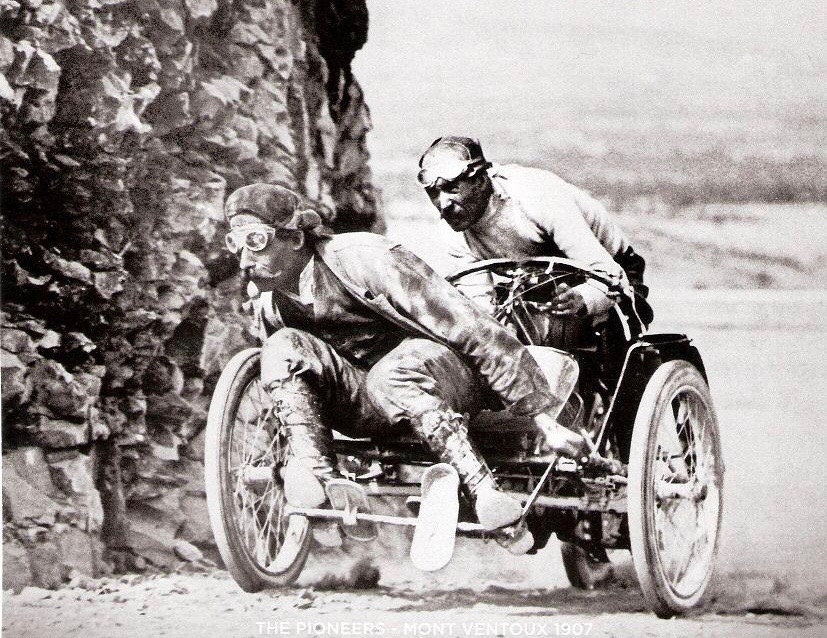
Cool indeed, but this is my favorite cycle picture. [1] It's technically a tricar, but given the handlebar controls and lack of bodywork, I think it qualifies. The vehicle is a Mototri Contal practicing for the 1907 Peking to Paris race [2]. These guys look like they want to win! They didn't, almost dying in the process. The passenger is a journalist. Motor-journalist Denis Jenkinson [3] did something similar later, acting as navigator for Stirling Moss in the 1955 Mille Miglia race, which they won.
Presumably this was what inspired Burt Monroe who broke the record in 1967 and was the subject of the movie "The Worlds Fastest Indian". I have always admired the engineering ingenuity of folks who break these records and never quite understood why the risk was worth it. :-)
That's a classic for sure. I would suggest a "heel clicker in a supercross race"[0] is also worth consideration, given the difficulty and risk involved.
There were a few years of professional cycling when people did this on downhills until they outlawed it. You don’t have much control when doing this. At least on the salt flats the whole point it to try to go in a straight line, so if you need to turn you’re already in dire straits.
This technique is still in common use here in the Dominican Republic, among honda cub street racers. It’s interesting that the most vibrant motorcycle racing scene is with motorcycles that were never meant to go fast and lack the frame stiffness or suspension to safely go above 50mph. I think the challenge of overcoming these limitations is what makes it compelling to the young riders and would-be-engineers that typically make up the illegal racing scene.
Typically the left lever is the clutch, right lever is the front break, and your right foot has a lever for the rear break. Not sure what the setup was for the record breaking motorcycle though.
Note that the bike pictured does not have a front brake. So I’m guessing he went back to his starting position at some point to hit the brake pedal. He first probably just rolled off the throttle until the bike got to a much slower speed. “Probably” meaning, it’s what I would have done, having already decided that riding a motorcycle at 150mph in my underwear is a good idea.
No. Usually one of the brakes (I forget which) is actuated with a pedal, and one of the handle levers (what would be brakes on a bicycle) controls the clutch.
Not in relation to his body which is the concerning interaction. Though contact with a 150mph tire would have had similar if not the exact same consequences as a 300 mph tire.
It's typically called "meat crayon". No need to look it up... it is like when a crayon is dragged across a piece of paper, and leaves behind a line of like color.



https://thekneeslider.com/images/2022/01/leray-citroen-motor...