> 5. Offer real healthcare and psychiatric care. Facebook employees enjoy various benefits, including private health insurance and visits to psychiatrists. Content moderators, who bear the brunt of the mental health trauma associated with Facebook’s toxic content, are offered 45 minutes a week with a ‘wellness coach’. These ‘coaches’ are generally not psychologists or psychiatrists and are contractually forbidden from diagnosis or treatment. And they generally cannot build a relationship of trust with moderators, since workers know that Facebook management (and Accenture/CPL management) ask ‘coaches’ to reveal confidential details of counselling sessions. Moderators deserve at least as much mental and physical health support as full Facebook staff.
Low pay and no psychiatric help with that kind of content?! This is just outrageous. Mark should moderate this stuff by himself to see how huge burden it is. And, this is not Rotten or Goatse type of shock it’s entirely different level.
"On the first day he took me to the officer’s bathroom and told me I would be responsible for keeping it clean. 'Here’s how you clean a toilet,' he said.
"And he got down on his knees in front of the porcelain bowl, in his pressed starched spotless dress uniform, and scrubbed the toilet with his bare hands.
"To a 19 year old who has to clean toilets, something which is almost by definition the worst possible job in the world, the sight of this high ranking, 38 year old, immaculate, manicured, pampered discipline officer cleaning a toilet completely reset my attitude. If he can clean a toilet, I can clean a toilet. There’s nothing wrong with cleaning toilets. My loyalty and inspiration from that moment on were unflagging. That’s leadership."
I had a similar experience while I was in the Navy. A new Chief Engineer came aboard, and I happened to be the watch officer the next time we lighted off the boiler in preparation for getting underway. He told me he was going to go with me to do a pre-light off inspection. He literally covered every square inch of the boiler room and engine room, crawling into bilges, peering behind equipment, poking into crevices, making absolutely sure there were no safety hazards. An excellent case of leading by example.
I've long thought this could be a competitive advantage for people to do "rotations" on different roles. Building tools for moderators? Do a week moderating. Building tools for salespeople? Do a week as a salesperson. You're a salesperson who needs tools built for you? Do a week on the dev team.
I once worked at a company that did something like that. It was optional, but once a year you could spend 3 days working in first-line customer service. A CS rep oversaw your responses, but you got an ordinary account in the customer service system and dealt with real customers.
The first two days you spent replying to customers, and the third day you spent prototyping or writing up some way that you thought common complaints could be addressed by making changes to the product.
It was a nearly unmitigated boon to the company. Sure, the company saw it as paying for a few extra vacation days. But the program stuck around because it generated a lot of good ideas, and the direct communication between CS and product development teams was valuable.
I worked at a company where this was mandatory for everyone — everyone — in the company. People who didn’t do it earnestly were let go. If I ever found a company you can bet I’m going to copy the practice.
Why would the company have to pay a few extra vacation days? It sounds like a temporary shift of personnel where somebody was out of their normal department but they were still working for the company. That's just a Tuesday not a vacay.
It was sort of a "working vacation" for everyone involved. The people working on the product were taken off their normal duties, and the CS mentors didn't exactly get a full day's work done.
Or at least shadowing if training for that role would be too much. When I was at Netflix, I did a couple of hours of shadowing at our support center, and just that alone gave me a whole new sense of how I could improve our tools and processes to not only make their job easier, but also get the information we needed as reliability engineers.
Yup, I don't understand why this isn't standard best-practice in most places.
When I ran a development shop, every year the senior staff spent a week physically working in their client's department eating their own dog-food (i.e. using the apps they built/supported). Once this was implemented it cut down on the post-implementation change requests by over half.
I'm a fan of such exchange initiatives, but I think they are not common practice for two reasons.
1. Limited provable return on investment. The effects are real but it's not like they're a panacea.
2. Human nature. There are a lot of people who are not enthusiastic about participating — because they are not cut out for the positions they're exchanging into for a spell, because they don't see the point, because they occupy a privilege place in the office hierarchy, etc.
I don't disagree. However, all of the points I made apply double for management — particularly the point about status in the office hierarchy. Management is often the most reluctant to participate in exchange; furthermore, the conversations you describe don't happen because management doesn't push them.
In my experience advocating for such initiatives — and I have done so across multiple organizations throughout my decades in the workforce, and not just at tech companies — it is not so much resistance from below as from above that stymies them.
This is what "real" Agile teams are supposed to look like: you embed that content moderator/salesperson/end user into your team, so they get to test out the product every week, suggest changes that would make it better, vote on what's built next, etc.
> you embed that content moderator/salesperson/end user into your team
I did just that on my last project and it was great. Another team was developing a similar product, but they didn't have an 'in house real user' so theirs was much harder to use.
At Sony Japan AFAIK new employees straight out of college are required to work at a retail location for 2 weeks. It certainly used to be that way. Not sure about now.
The teams I've managed, every person has to rotate thru every role, eventually. Not just some tasks. The actual role. Be the SQA person in charge of acceptance testing. Write some code. Go out on sales calls. Proofread some copy.
Quickly pops people out of their focus on local optima, to better see the whole.
One my the formative places I worked had all software folks do a rotation shadowing customer support reps. What a wonderful experiences for building rapport, and developing an understanding of customer's actual pain points.
It's probably more that people who don't have the right training/have not passed various exams and certifications are not allowed to do certain things in finance. You can't sell securites if you haven't passed the Series 7 exams, for example.
Some years ago a relative of mine was hired to be a Regional VP for a very large restaurant chain. As part of that training he had to spend literally weeks of time learning the basics in each role in a restaurant, from waiting tables to cook, to (end-user) cleaning & maintenance of equipment, assistant manager, general manager, regional manager, to their position.
I've always thought that was a fantastic form of training, and spoke strongly to the fact that the chain has been around since WW II.
It makes a lot of sense. How can you be in charge of running a business when you don't know how the parts work and what it means for an employee to have to perform their duties?
Definitely not enough if they don't understand just how much they're pushing these moderators to desperation and breakdowns.
A couple of days is not enough to get the gravity of the situation. Spend a week or more looking at the filth that needs filtering and you might start to get a sense of what the mods deal with and how badly it can affect them. Maybe.
I agree with you wholeheartedly, but capitalism has allowed this kind of thing for generations.
Mining magnates should be forced to work at the coalface. The Waltons should be forced to stock shelves, Bezos should be in the distribution centres.
The list is endless, and unfortunately this is nothing new. The best we can do is minimum wage laws and unions to try and "negotiate" with billionaires to give us a crumb.
Falling back to social engineering and forced labor (hopefully) won't win you many points in the "let's re-architect the system" debate. If the Waltons never stopped stocking shelves and started scaling, we'd never have Walmart. It's possible you think that's a good decision for the world, but it's clearly not the worlds decision for itself.
Amazon employee here, speaking for myself, not the company. When I was hired, every senior employee (IC and manager, regardless of role) had to go work in a fulfillment center for a week sometime during your first year, learning and then performing all the jobs.
I’m a computer guy, but there I was loading trucks, packing boxes, etc.
It was a fantastic experience and connected you viscerally to the business. I believe it is still required. This is the culture that Jeff shaped for the company.
I've long thought this was an interesting model, and I've known that Amazon follows it, or at least did at one time.
I wouldn't overstate it though -- the ability to tolerate a week of something does not necessarily extrapolate to a month or a year.
A week in the rainforest is an adventure. A life in the rainforest is difficult and short.
But I don't intend any criticism of Bezos. He has done the math on warehouse employee satisfaction as a contributor to corporate goals, and made his decision.
The scrappy days of packing his own shipments are long past, and that experience gives him not-much insight into the working conditions for the people in his warehouses.
That's fine, but it's not a basis for deification.
I think it depends on the attitude of the employee. For the people who have good attitudes where working there fulltime is character-building, they are over-qualified. For the people who aren't qualified to have a better job, their attitudes about things suck.
For you, I imagine it was a week-long challenge where you knew that you would have a better job afterwards and make a lot more money.
You don't live in a capitalist system. You live in a hybrid system that is heavily regulated. The way these regulations are agreed on and applied is what really matters. Your comment is not only wrong, it is also rude in that it disallows discussion and can be summarized as "love it or leave it".
Are you suggesting that line workers have the capability to define their own jobs?
The conversation here is about people that take these moderation jobs (pick any of a dozen reasons) are getting shafted compared to the duties required.
Admittedly this is an attempt to shape their circumstances, but it's not in keeping with the way corporations work to suggest that workers can just say no.
Line workers can switch jobs if they are unhappy with the conditions. If everybody would do that, companies would be forced to make those jobs more attractive to retain and compete for workers.
"Love it or leave it" means there is no room for discussion. It can also be considered a veiled threat especially given its historical use.
It's a false dichotomy. I already told you, you don't live in a capitalist system. You live in a hybrid system where all markets and contracts are already regulated.
If you believe otherwise, try ignoring labor laws. Try ignoring OSHA. Try ignoring EPA. Try getting someone to sign an indentured servitude contract. You'll quickly learn that the world isn't that simple.
The argument "we already have all those rules" is not really useful. Apparently the treatment of the Facebook Content Moderators is also legal. So by your logic, it is OK, because we already have those rules.
I don't know why you think "love it or leave it" is a veiled threat. What historical use are you referring to? Of course it is abbreviated. You can negotiate with your boss if you are unhappy. But ultimately, nobody owes you anything. Yes, there are the labor laws and so on, but I think if somebody decides to shut down their company, you can not really sue them for your job anymore.
Yes, normally you are. We are in a CVOID19 world, which makes that a little more problematic.
Still,e the fact that unemployment is dropping and people have found new ways to make money, despite old jobs potentially disappearing forever, is actually a strength of capitalism.
Socialism say, "Don't worry we'll take care of you. Here's some welfare," and people become dependent on the State, and the State might give you some new job options to pick from.
FDR's new deal gave people jobs that weren't even necessary (Got into a building in TVA and look at the rows and floors of empty cubes; they had a secretary for each floor) and even though people knew that, there was still a sense of pride that at least they were working and trying to contribute. That aided more creatively, and more recovery.
COVID is the ultimate test of Capitalism for people to rise up within the new rules of this horrible system, a one where leaders are saying "You literally cannot run your small store, but we're going to let this massive chain keep working" .. where they are literally removing your Capitalists freedoms, and the ones who will survive are the ones who say "Fuck this .. I'm going to find a way to keep afloat .. time to get creative.." and suddenly your store is selling masks and creating more fabric waste to fill our oceans more than ever!
You're either a troll, or _really_ confused about what Socialism is.
I know this isn't the spirit of comments HN encourages, but I really can't afford to waste the time on writing a thoughtful reply to someone who is, most likely, purposefully ignorant. So I'll just link you to Wikipedia instead:
Socialism is not a definition on Wikipedia. Also, is this a joke: "A non-market socialist system eliminates the inefficiencies and crises traditionally associated with capital accumulation and the profit system in capitalism." - that's on Wikipedia? Seriously?
That is the dream version of socialism, not the reality. In reality socialism consistently fails to "eliminate inefficiencies", rather, it does the opposite.
But we shouldn't discuss socialism here, that is true.
I merely stated what would be the reality under socialism (which has been the case in previous attempts to implement socialism), which is that you would be assigned a job and you would be supposed to gratefully do it for the common good, not for personal gains.
I have friends to grow up under socialism. I suspect many Americans simply live to far away from real socialist countries. I guess you could ask Cuban refugees what they think, though.
Capitalism does not force you to create an immoral business, or to treat your employees (direct and contracted) immorally. It doesn't even really encourage it. Wanting more and more money regardless of the (human) cost does.
> Capitalism does not force you to create an immoral business, or to treat your employees (direct and contracted) immorally. It doesn't even really encourage it.
It tends to encourage it by putting those at the top who manage to exploit the most. Capital also begets political power which makes it hard to counter that trend.
> Wanting more and more money regardless of the (human) cost
Congratulations, you've accidentally defined capitalism.
False dichotomy. Economic systems contain hundreds of sliders a country can adjust, from various tax rates to workers' rights. Adjusting one of these has nothing to do with Stalin's USSR or Mao's China, so I don't understand why you're bringing those up.
Every country in the world and every civilization in the history of mankind is an example of "what else?". The US isn't run on pure capitalism, and it never has.
Some countries do better than others, in various metrics. That's the "what else" you can look at and emulate.
I disagree, e.g, europe, not pure capitalism, not pure communism, not pure socialism, but somewhere in between (depending no country). Overall these countries are not less successful than US (which is also not pure capitalism), and most of it citizen prefer living in europe and would not consider moving to the US. More socialised forms of healthcare, education and unemployement support are main reasons.
It doesn't really add anything to this conversation. "Blame Capitalism" is all the rave, but it doesn't really fit with this argument. There is a lot going on here. One, this is a letter to Facebook when it really seems to be the contracting agency that's at issue. FB may just order their contractors to be like "stop this shit" and they comply, or they buy out the contract and move people in-house.
People only have so much time and capacities. A software engineer isn't going to spend a lot of time on the sales room floor, but they might have started off in help-desk support. A CEO might not know what goes on in the warehouse, but he or she may have worked at a McDonalds growing up. If someone hasn't worked entry level jobs elsewhere, would working on the factory really develop empathy? Would that change policy? Probably not.
It's so easy to make two boxes, one for the oppressor and the other for the oppressed, and place everyone into those two boxes. If each oppressor works a day in the shoes of the other box, does that make a difference? If the workers throw their wrenches into the gears and seize the means of production, what if they're completely unprepared to keep that machine moving and end up with famine?
The issues are complex, much more complex than "Before you get your license, you should have to ride a bike on the streets for two weeks."
Zuckerberg has been to trial in washington and had to speak about AI approaches. This is not the first second or third time international news has been made making objective statements about the technical failures of the product facebook is wants it's moderators to use.
To say he has not been made aware and had the opportunity to address these issues over years is giving him too much credit.
Blame capitalism is all the rave. So are companies hiding from responsibility. Shell companies shell companies to evade responsibility and incing their companies on remote islands they clearly don't primarily operate on to evade taxes and giving abuses NDAs which effectively offer full silence regardless of any federal felonies committed or else they take severence or healthcare taken away. Companies can do whatever they want under an NDA and sue anyone to the point even if they did something very illegal, they still wouldn't be liable because the fact that someone spoke about it is illegal in the same way a VC investor was caught beating a woman 300 times in a row as she tried to escape the guys san Francisco mansion but the evidence was thrown out because it was obtained illegally and he got a $500 fine instead.
Blame capitalism exists because publicly shaming companies away from egregious abuses even to the point of being often illegal is the only way to have some type of check and balance and it always takes a few people beginning by speaking out and losing their jobs and getting nothing for it before the masses come to agreement and hold companies responsible for better practices. Unfortunately this is not just a fun trend. It's a reaction that attempts to check and balance abuses and it often only happens after many yrs and many people have gone silent and a few have chosen to take the risk and speak out. We should definitely have something better than blame capitalism but to say it just appeared out of the blue is a bit misleading.
> It's so easy to make two boxes, one for the oppressor and the other for the oppressed, and place everyone into those two boxes. If each oppressor works a day in the shoes of the other box, does that make a difference?
You've got a point there. The capitalist will most likely continue to act as a capitalist. The incentives are fundamentally wrong, so moralizing on an individual level won't do much, which brings us back to: blame capitalism.
I don't mean to be mean and I support the plight of the moderators but this is just simple supply and demand. What are the skill required to be a moderator: eyesight and motor functions. Who has those skills: almost everyone. What will the companies therefore pay: almost nothing.
I think the best thing that can happen to those jobs are they they are automated out of existence with AI, or heavily reduced,
You don't mean to be mean, but then follow it up with such a tasteless and repugnant comment. God help those in your life if this really is your attitude towards living, breathing humans.
It's possible you were right, if we can interpret the "attack" as being purely intended to undermine the original argument.
I just didn't personally interpret it that way... it looked more like a side-observation to me, something like "name-calling" under Paul Graham's categorisation:
Lol not everyone is built with the mental and emotional capacity to not be scarred in that type of job. Sure, they can switch jobs, but it's pretty much like having an employee do welding work without protective glasses. Guaranteed consequences for them in the long run.
Or is it really? I am honestly curious what are the arguments? I can find one to the opposite, like humans did not evolve in the arc welding environment, while the cruelty was not unknown to our ancestors. I would expect that there are many people well equipped to deal with the latter.
Yeah, I'd agree that no-one is, which is exactly why I also think this kind of job should be automated away -- to spare the real humans from having to deal with emotional cancer.
I spent ~6 months working on tech to detect potentially-suicidal people online (which required a lot of manual flagging and review) and it's one of the most emotionally draining jobs I've ever done. It's a weird feeling to think it's an incredibly important job, but not want to recommend anyone ever do it -- that seems like a perfect role for automation to slip in.
not everything is supply and demand. we have a "mostly" 40 hour work week, not because that is what is needed for demand, but it is enforced by labor laws.
I see no reason why there can't be a mandate to provide mental health benefits to these workers. It is absolutely a safety hazard.
This might border on useless, but to me, if the workers for the most part "demand" a 40 hour work week, and for the most part "demand" over-time pay, etc, this isn't a breakdown in supply and demand. Anarcho-capitalists should support workers demanding things - they just should also support scabs working anyways. Supply and demand applies to labor - if the labor does not supply itself - it creates demand for better conditions! The most tautological comment I may ever post!
While your logic is correct, it is ignoring another argument.
Individual workers might not price in the societal (or individual) cost 20 years from now of breeding mental issues in these workers now.
Or another example: You own 50% of the forest land in your community, which for sake of argument produces 50% of the community's oxygen (assuming a closed system). You start cutting down the trees to produce furniture and sell them. Generally the cost of oxygen production is not priced in, and down the line, someone will pay for it. Either individuals getting sick, universal health care, environmental efforts in replanting, regulation on land maintenance, etc, etc.
I suppose you will argue that each individual will need to save a buffer for every network effect for every purchase decision they ever make that doesn't price in externalities, in pure capitalist spirit. But I hope my point hits that there has never existed such a system, or if it did, it died out pretty quickly, and left no trace in history.
We can and should all have opinions on health regulation, environmental taxes, etc regarding what their effect ultimately becomes, but everything from societal mental health to environmental effects will always leave a bill, and someone will pay for it. The only thing we can discuss is if it should be everyone for themselves, our great great grandchildren, taxes, or corporations selling crap too cheap (or in OPs case for free).
Even with trained psychologists or psychiatrists there's a limit to how many times you can put your hands in the fire before it's impossible to craft some skin back.
The resources are limited. What is better, employ more people with a smaller pay or less people with a higher pay. I understand that this kind of job is not for everyone. And I assume the potential employees are well informed about it. And if it is worse than they expected they may look for another job? I just think there is enough people able to do that kind of job without experiencing any significant mental ill effects.
Wtf, people who work at computers, having to work in offices, now? It’s the very worst it’s ever been! What are they thinking?
I’d expect almost everyone who works at a computer screen to be working from home since March. Even if it requires expensive technical solutions to ensure it. I can’t imagine moderators need more than an internet connection and computer.
My understanding is that there are certain legal requirements associated with content moderators who may have to review illegal content, especially around child abuse / sexual imagery. This is what I've been told in the past by friends in other companies working on content moderation -- I don't have any specific evidence for or against it, but it passes the smell test.
The whole thing in the article about Facebook suddenly trying to automate this part of the content moderation job seems to also point in that direction.
> Management told moderators that we should no longer see certain varieties of toxic content coming up in the review tool from which we work— such as graphic violence or child abuse, for example.
If they are forced to be in the office then the office should be as covid safe as possible. I imagine these content moderators work in something akin to a facebookized phone bank 'pit'.
Given that no other facebook employees are being forced to work in their expansive offices perhaps the content moderators, if they are required to work on site for security purposes, should be given the run of the empty space. That way they can easily social distance appropriately.
Then they have a problem (legal, economical, practical). They shouldn't make that problem their employees' problem though. Solutions include stopping moderation, or suspending operations partially or completely. For example, if they prevented image sending/posting for a few months, their moderation workload would likely be lower.
My principle concern would be, no matter the employment relationship, you can't contract away criminal liability. (At least, not in the US.) So here you opened something while working from home, that maybe your state's child sex trafficking task force was tracking. It could just get messy. I'm not sure I would even want to do that kind of work from home.
Isn’t being on a company laptop and VPN enough to equate you being “at work”?
In healthcare, totally different but highly regulated, we can let people work from home with HIPAA protected info by securing the way they work and access the info.
Not an expert, but I can imagine that a VPN and company laptop doesn't matter in the least when it comes down to Facebook sending certain material to employees, a legal battle coming of it, and the transmission occurring within vs. across state lines.
There must be some solution though, like requiring that the VPN connection originate from an address considered to be in the same state.
Given that some US states are so fucking crazy to brand a 15 year old, who sends a sext of herself as a kiddie pornographer and a sex offender for life you may be on to something here.
It seems ridiculous, but very possible.
That doesn't excuse Facebook's despicable treatment of their contractors who have to wade through that filth.
The fundamental nature of moderation on something like Facebook means that moderators have access to a lot of sensitive, personal information and images. If they let moderators take that information home they basically lose any control or ability to stop them from copying it.
I'm working for a global financial institution in a country, which takes banking secrecy very seriously (such as in criminal offense and jail time seriously).
Within two weeks all employees, which weren't not needed at the front line or personally in an office were moved to home office. The company was able to move 10s of thousands of employees in a couple weeks securely and reliably (safe for a few glitches, which are to be expected on that scale).
There are reliable solutions to completely segregate what's happening on corporate systems from a simple, employee owned laptop connected from home.
Sure, you can make pictures of the screen, but you can do that in the office too. Then again you can just print it, while at the office. Something which you can't do at home.
So no, I don't really buy this reasoning for a company fancying itself totally hi-tech.
If the issue is visually surveiling employees and their computers, can't that be solved for remote work by issuing every employee a camera and tripod to be situated over their shoulder, remotely monitored by whoever was physically monitoring employees on site?
If the video feed goes dark, the surveillance operator could trigger a forced shutdown of their laptop (or even better, disconnect their RDP/VDI/etc. session).
People are very psychologically affected when they feel they are being constantly observed, especially when that observation is only for punishment.
There's a story from an Amazon warehouse recently where a guy had a heart attack and didn't get found for 20 minutes. A few days prior he had put something back in the wrong place and management came to him in 2 minutes. Do you think Facebook overseers would be any different?
It is absolutely disgusting to read about the brutality and disrespect with which Facebook treats its moderators, but that disgust can only pale in comparison with what the moderators must be going through every day. "AI"-driven content moderation at scale is completely detached from reality and from the nuances of human language, a target that only naive technophiles would pursue. These moderators truly are the heart of the company like they claim, yet receive the worst possibly treatment. Get your shit together, Facebook. Everybody who works there is complicit for the brutal treatment of your coworkers.
Wages are the price of labor, and like all prices they are dictated by supply and demand. If there were fewer people both capable & willing to do the job, wages would rise.
People choose these jobs because they are the best options available to them. This is true for many undesirable occupations (such as janitorial services).
One of the benefits of UBI that nobody mentions often enough is that when everybody can afford to survive independently of a boss, labor will be priced according to how unpleasant or dangerous it is to perform, rather than according to the desperation of the class performing it.
It's quite gauche to label jobs as skilled or unskilled so I'll make no determination. But I assume you're talking about the UFCW. I had no knowledge of this union before your comment; I will admit that it changes my perception of unions as a whole.
It is a low-paid job because it is easy to find someone to do it I assume. Unfortunately, salaries do not reflect how a job benefits society, or how hard it is, it is just a function of how hard it is to find someone to do it.
Police are paid extremely well. For example in 2019 every officer in Seattle made six figures, and about a quarter of the department made over $200k. This is part of why there are so many calls to defund the police.
It's kind of amazing what unions can achieve when they're allowed to exist. I think cops are the only folks who get to unionize without the cops beating them up.
Yeah, nurses and EMTs should be paid more. All the EMTs that serve Seattle get "based" out of city limits and don't even make the Seattle minimum wage. You can make more as a dishwasher, and dishwashers don't have 24-hour shifts.
You can't determine the toll being a content moderator will have on you. How are you supposed to determine whether the job is worth the salary? The true costs come later. This suggests a legislative approach to the problem but, good luck. It was hard enough for California to define "contractor". I doubt this approach will be fast, accurate or effective enough.
This post sheds light on a very simple but important age old lesson. Judge people by what they do, and not what they say.
While corporations like FaceBook would purport to have liberal values, in reality they hold these beliefs only insofar as it furthers their own financial well-being. While the elites in this company seek to concentrate wealth and power, those at the bottom receive scorn and poor working conditions. Image having to work such an emotionally draining job, and not being given the mere dignity of being a full-time employee.
This sounds rather dehumanizing in my view. You are just there for labor, and they will do everything they can to minimize the amount of monetary value that they provide to you. This means humane working conditions, inclusion, respect, and psychological support and are all liabilities for them.
It's not just the corporations and the elites. It's the people working at these companies, and that includes many HN contributors.
Would they vote en masse to form a Union to stop these issues arising in the first place? Personally I doubt it.
It seems to me that many people are happy to take the large pay check every day, and see themselves as "the good guys" (as everyone does) because they donated to Biden and attended a BLM march or put pronouns in their bio.
Yet the homeless problem outside their front door never seems to get better, and they have terribly paid and horribly treated people working in their own company, and they seem (from the outside at least) to be doing very little about it.
Of course Facebook is just one of many companies with the same problems. And the political Left abandoned the working class a long time ago. It's a systemic issue.
The diagnosis of the fact that it is a systemic issue is certainly accurate in my eyes. We need a system of incentives that would make the class of people that you identify as "HN contributors" to feel that the cost of their cowardice and complicity is greater than the affluence and power that they obtain by going along with the system that they are beneficiaries of.
Is there a particular logical reason why Facebook required these people to get back to office? Is it related to productivity? Would be curious to hear Facebook's take on this.
Where else can an employee browse filth all day in a secured environment? Free from the eyes of children who may be doing pandemic schooling from home? And indemnified against criminal liability for opening up certain troubling related content by an authoritative, audit ready, third party recorded video feed?
There are just legal requirements around certain types of porn for example. Or videos of illegal activities up to and sometimes even including murder.
Law enforcement authorities only tolerate a certain number of mistakes in this regard. With certain content, they may not tolerate any mistakes. I'm not saying FB is right. In fact, FB probably didn't even make the decision. They outsource. What I am saying is that FB, with the content they want their contractors to moderate, are putting those third parties in highly precarious legal positions. I don't blame those companies for acting to protect themselves if FB is not willing to take on all legal responsibility for things that may go wrong.
>There are just legal requirements around certain types of porn for example. Or videos of illegal activities up to and sometimes even including murder.
If I understand your point, it is law enforcement doesn't allow moderation of these items outside of a certain environment? If so, can you suggest further reading of the laws for this area? I have never heard of them.
My point is not that law enforcement won't allow moderation outside certain environments. It's that law enforcement specifically forbids possession of, or even access to, these materials by anyone. FB likely has some kind of working agreement with law enforcement which allows them to do the business of moderating and reporting. Does that agreement extend to allowing FB contractors to access child porn from home? I'm in no position to say since I'm not privy to the details of the arrangement.
I'm saying as a contractor, as the low man on the totem pole, there is no way I would want any of that content touching my home network without an iron-clad assurance from every level of law enforcement that I would not be prosecuted. An assurance from your local prosecutor probably means nothing to the guys at the US Attorney's office. (And sometimes even vice-versa.) Accessing those materials in a secure environment that is audited and recorded, in direct partnership with every level of law enforcement, avoids issues of that content touching your router altogether.
I can't imagine that any person who understands criminal liability would actually want to do this kind of work from their own home networks.
I'm not sure exactly how this works in tech. I know lawyers who have worked on child abuse cases and they had tight restrictions on the evidence. Only the trial lawyers could request access. No paralegals, no sectaries, no copies. Only select Lawyers, the jury and the judge could view the evidence, and it was all controlled by the Justice Department. (I knew a lawyer who refused to look at the evidence, only the descriptions, because he didn't think he could handle defending him otherwise. He did successfully defend him though).
I suspect for Microsoft, they have some preliminary hashing algos that automatically send known media to a particular people with the same Justice Dept exceptions and controls for chain of custody. Other people may see content of course, but it would likely get flagged and shipped to people who were authorized to deal with it. You don't want a lot of people on that list obviously, but when it's just a few people, they get a constant stream of nightmare fuel.
I imagine they don't even want the fingerprints "getting out". Imagine if you had the fingerprints and the algorithm. This can't possibly be a cryptographic hash (too fragile); it's got to be possible to find "collisions" that have no relationship to the original image, and probably don't even look like images of anything at all.
Imagine the chaos someone could cause.
It'd be like back in 2010ish when somebody encoded a bunch of malware into bitcoin transactions: every bitcoin node running any kind of antivirus software was immediately kicked offline. Many AV programs deleted their owners' copy of bitcoind. It was madness. Forced the bitcoin developers to store the blockchain on-disk xored with a different random number unique to each computer.
I think it is simpler than that even. Imagine the scandal if some content moderator working from home copied over and saved child porn he found during moderation, and perhaps even redistributed it. Doesn’t even have to be child porn - could just be e.g. sexting messages between adults.
Just imagine the fallout for Facebook if a contractor slips up and opens up a laptop on the train or at a coffee shop. It doesn’t have to be malicious, just negligent. And as recent scandals at Amazon and Twitter have shown, employees are as vulnerable to bribery and social engineering as any other human. Even if Facebook is legally covered, the PR risk is too great.
If this were a legal requirement, the actual facebook employees would have been brought back.
They haven't been, just the people contracted by CPL/Accenture to work at FB, which leads me to believe that this is not a legal requirement.
It's presumably that FB said you need to ensure security to the companies, and they decided that the easiest way was to bring everyone back to the office.
Reading between the lines, it looks like these people are employees of contracting agencies to which the content moderation has been outsourced.
If I had to guess, I suspect that the motivation to bring people back to the office comes from content security issues. Not all content flagged for moderators is actually objectionable due to errant or malicious flagging. It's impossible to guarantee that private material will stay secure when it leaves the premises.
I'm on the side of the content moderators here (should be allowed to work from home) but it's not difficult to imagine the headlines criticizing Facebook for allowing private content to be viewed, and potentially shared, by content unsupervised content moderators working at home.
I understand these moderators are contracted out, but maybe, just maybe, this is a sign they really need to change the way moderation is done. Maybe they need to bring people back in-house and change moderation policies before legislation does it for them:
If I where a Facebook investor and read this, the thing I would focus on is:
The AI wasn’t up to the job. Important speech got swept into the maw of the Facebook filter—and risky content, like self-harm, stayed up.
The lesson is clear. Facebook’s algorithms are years away from achieving the necessary level of sophistication to moderate content automatically. They may never get there.
Most technical people have guessed that Facebooks AI wasn't actually any good. The non-technical world, like politicians, assumed that it was easy for Facebook to moderate. Facebooks magical AI could censor anything that governments deemed offensive. It turns out it can't, but Facebooks has done nothing do inform the world that their AI is no good. Admittedly I guessed that it didn't actually exists and was simply a keyword filter.
Leaving aside the obvious horrors exposed by this letter... one of the buried ledes here is the internal confirmation that AI-driven moderation has failed, and the implication that FB will have to spend significantly more money on human beings going forward.
How many people do you need to moderate the interactions of half the world's population? It's going to require a lot more than tens of thousands of people, and those people will need to be paid a lot more than 18 dollars an hour.
The TL;DR is that around 200 content moderators, location unspecified, are protesting decisions to move them back into the office.
It's not immediately clear from the letter that this was Facebook's decision. In fact, it appears that Facebook subcontracts content moderation to Accenture and CPL, both of which are named in this letter.
The letter also takes shots at Mark Zuckerberg's growing wealth and attacks Facebook's attempts to augment the human content moderators with AI pre-filters to remove the worst content. The latter claim is strange, as the content moderators are the ones most likely to benefit from AI pre-filtering. They try to claim that Facebook "failed" to create a workable AI, but I seriously doubt that Facebook has given up on the project. More likely that they're still iterating. I suspect these people feel they need to attack the AI angle to protect their jobs.
The letter goes on to demand 50% higher hazard pay, demands that the subcontracted content moderators be hired directly into Facebook as full employees, out of their contracting jobs under consulting firms.
Facebook should bear the brunt. In a more reasonable arrangement (in which, the generator of risk has to bear the liability), these people would be direct employees of Facebook.
> in which, the generator of risk has to bear the liability
Do you think this in general, or just for content moderation? For example, is it reasonable that I can buy car insurance that covers me if I cause an accident?
My parent was saying that the generator of risk should always bear the liability, which confused me because there are many situations in our society where a third-party agrees to take it on in exchange for a fee. I described car insurance, as one of those situations.
You do bear the liability for the risks you create by driving your car. Paying your car insurance company premiums means they agree to pay up to a certain amount of money for you to cover damage, but that doesn't remove your liability. In addition to the fact that it's you paying the premiums, if you get a ticket, it's still you that gets points on your license; if you injure someone because you were driving recklessly, it's still you that gets sued (and if the damages awarded are more than your insurance covers, you're still on the hook for the rest); if you injure someone while driving under the influence, it's still you who gets charged with a crime.
ah I see. I don't view insurance as shifting the liability itself (more like a payment plan for the expected value of the liability), but I can see why you might look at it that way.
> For example, is it reasonable that I can buy car insurance that covers me if I cause an accident?
Reasonable? I’d describe it as mandatory, and not even a question in no-fault jurisdictions. It doesn’t exempt you from criminal charges if you did it, say, intentionally.
car insurance doesn't remove liability, it will pay agreed upon sums of money to cover damages, but certainly anything criminal will still be pursued. And people can sue you for more than your insurance might cover.
I’m not sure if this is what you meant, but in the UK you can buy comprehensive insurance that will cover damage to your car as well as the other person if you caused the accident.
> It's clear that they want Facebook to bear the brunt of the bad PR
That's the right thing to do, considering FB is the only entity with some power over their employers. Avoiding this kind of thing is exactly why brands outsource their dirty work.
If part of someone's work responsibilities involves screening for child abuse and other direct violence, and every other depravity a user might try to post, that worker should be given the best possible mental health support, and be paid substantially more than any minimum wage.
Like anyone serving in the military and possibly subject to all the PTSD and injury that combat can entail, these moderators are standing as a thin line against the worst things humanity can do to each other.
They should be given respect and every possible consideration for their sacrifice.
Their demands are merely a simple first step closer to the recognition they actually deserve. I would go much further.
Yeah, but it's AI-complete. Its an adversarial problem also, as people are really motivated to share their content.
It reminds me of the filters on facebook that kept killing compliant nude pictures of larger people, because the model had obviously just learned to count pixels of skin.
It'll be a long time before this work gets automated, and until then, they should support their moderators.
The cynic in me thinks they're still working on it, but the first test cases they're concerned with are about removing copyrighted content. Then they'll see how to apply it to other problems.
I'm wondering if there is also an element of: you should be surveilled while you moderate content, as otherwise you could steal it. It's a hard problem as moderators have access to user data (I imagine).
I imagine they are not, I imagine they are presented with a neverending series of captcha like screens.
Content at the top, buttons down below to classify why it needs to be banned or if it's ok.
If more context is needed i'd still be hiding user information from the moderators but maybe pulling up some number of posts 'around' the suspect post.
I imagine that a locked down laptop running just the moderation UI provides reasonable security. If not, the camera can ensure that the moderator doesn’t use the “analog hole” to copy video or image content. Forced use of headphones instead of speakers finally almost closes the gap for audio.
Video and audio too risky. We're gonna have to go with a neural interface and implanted DRM chips. I bet Time-Warner Media has patents they can license. :)
True, I should have said "cheap." Because when you cheap out on maintenance, you're making a choice to lose long-term value in favor of short-term gains.
I agree, I think we should have a society where everyone is free to earn the entirety of the value they create, rather than having others take that value for themselves.
If they didn't exist, it wouldn't take long before Facebook didn't exist. They'd either lose users hand over fist, or be sued out of existence for illegal content.
I agree that they're quite important and if they had a general strike, FB would turn into an absolute shit-show overnight, but I also thought that was a bit much.
I never had facebook on my phone and I dropped whatapp for signal. IG is the last piece I need to get rid of besides those apps I don't care about with the "sign in with facebook" crap.
I'm trying to quit IG so my next phone will be fb free but does anyone have any recommendations on how to make dropping IG easier? So far I made a group with friends so we can spam pics but it's not the same (probably cause not enough of us is spamming it)
Whatsapp (haha). But seriously the answer for me to de-social media myself in general was to focus on the few relationships that matter to me and message them directly. Phone calls, facetime, direct messages.
Whatsapp is the primary way I do this because of it's global reach, but you could get away with sms too.
The best corporations are heartless machines (in this case this applies to the contractors primarily, not sure if FB would mind if the work is getting done).
We should be thankful for the jobs that we have today. Corporations of the future will not need as many warm bodies. (Sarcasm)
We should, but we are not doing that. We have been cleverly manipulated to care more about what a soon-to-be-ex president said or didnt say or how many genders actually exist. You can protest against everything except those things that are against the interests of the rich and powerful. The protests are channel to serve their interests, not the other way around. Dont believe me? Just a sample: https://trends.google.com/trends/explore?date=today%205-y&ge...
I'm glad that you don't have a time machine. So you can't back and persuade those who worked 16-hour days in unsafe conditions that they should be thankful for the jobs they had then.
What's interesting is that Facebook, like Google, and other similar companies, are absolutely the best places to work at with the way they treat their employees, the benefits, etc. So now imagine how most companies treat their employees...
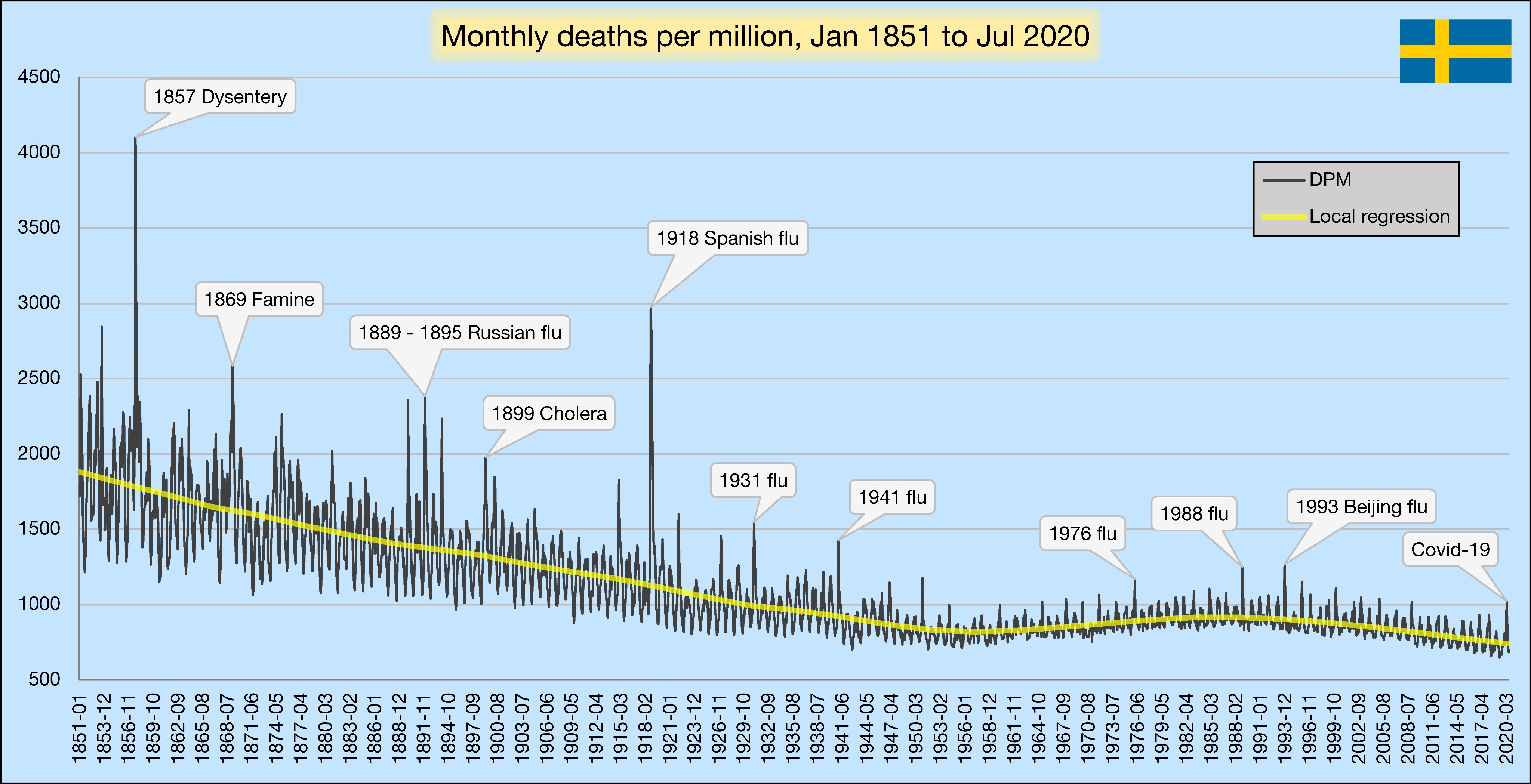
According to the statistics from Sweden and Germany, 2020 deaths are tracking the same as prior years, and the death spike in Sweden from COVID is about the same as the 2009 Swine flu pandemic.
So in regions with reasonably healthy people, its not clear that COVID is actually more deadly than the regular seasonal viruses we have been dealing with for the past few decades.
> During the 15th week of the year, we saw the highest death rate in Sweden this millenium. A total number of 2505 people, 358 a day, passed away. Not since the first week of year 2000 that many people have died in Sweden. The 14th and 16th week of 2020 is third and fourth respectively on that same list. The month of April is the deadliest in Sweden since the 1990s with 10 458 deaths. You have to go back to December 1993, when 11,057 people died, to find a higher figure. At that time, the flu was unusually malignant. If you go past that month, you have to look back to 1918 and the Spanish flu to find a more deadly month.[0]
That study was done in Denmark, where national guidelines on social distancing appear to be more uniformly applied & followed than in the US. It may be the case that, properly social distanced, masks add little to protection. However, given lax or non-existing distancing measures in some places in the US masks could make a larger difference. Anecdotally it appears that states with less social distancing & mask usage, on average, are experiencing worse spikes at the moment. Of course the question is whether it's lack of masks and/or distancing that's the cause. Unfortunately, lack of social distancing & lack of mask wearing appear to be closely correlated in the US so it is difficult to disentangle.
What we do know for sure is that masks can prevent a certain amount of exhalation droplets, and there are plenty of other studies that point to their efficacy [0]. Given reasonable evidence in one direction, less evidence in the other, but perhaps still a lack of consensus, it seems like taking a very simple step that could save lives is still the prudent & responsible step to take.
Other decisions on things like which businesses are able to stay open, which closed etc., do seem arbitrary at points. However, if lines have to be drawn somewhere, edge cases close to those lines may always seem inequitable. Personally my main criticism is that we don't have stronger guidelines that deal with more detailed scenarios at the Fed level, that states left to their own devices are often no more consistent, and municipalities are often left to try & figure it out themselves.
Balance with missed heart bypasses, cancer screenings, emergency stroke interventions, and increased stress, and interrupted vaccine programs, and alcoholism, drug abuse, suicide, and that list goes on too.
When cancer detection rates go down, it doesn't mean cancers went down, it means people aren't coming in for their regular mammograms and colonoscopies. 5 months can mean the different between an early treatable cancer with a 5+ year survival rate and a stage 3 malignancy with the survival rate dropping by 1/3.
Five years from now, we'll look back and be able to see the massive secondary deaths from cancer, heart disease/obesity (people stuck inside all day), depression/suicide and others. This will not be a time of honor.
They're not missing the secondary effects. There's constant attention on those effects.
> Across the world, rates for attempted suicide are growing dangerously amid the continued lockdowns
This is incorrect. Realtime monitoring data have not shown an increase yet in deaths by suicide. These are early figures, and we do need to guard against rises in future. But there has not been an increase.


Low pay and no psychiatric help with that kind of content?! This is just outrageous. Mark should moderate this stuff by himself to see how huge burden it is. And, this is not Rotten or Goatse type of shock it’s entirely different level.