I've been wondering for a while if vertical solar panels on the sides of buildings might make sense. Today (for no reason that I know of) I started wondering if might even make sense to put panels on parts of a building that don't directly face the sun at all.
That's what lead me to this particular article, which examines the efficiency of putting panels on north facing roofs.
I explored the vertical panel idea in a blog post last year: http://curtisb.posthaven.com/the-solar-garage-door. I don't know if that idea would work, but I was trying to imagine an application of the idea so absurdly simple that a startup could easily use it to bootstrap into a more lucrative market.
> parts of a building that don't directly face the sun at all
Bifacial panels (where one side faces the ground) are almost on the market for solar plants. The ground is generally light colored sand, which is great for diffuse light, so they see ~30% extra insolation for the same silicon.
Generally, you don’t run out of roof space before meeting a 2 story buildings energy needs. On taller buildings installation costs would be significant, coupled with lower effects and it’s more viable to put them just about anywhere else.
The garage door is a rather complex place to put them as their are a huge range of styles and you would need to either fit the opening and replace the mechanism, or design a door for each existing type sold. On top of that wiring up solar to your house is the tricky part not putting something on a roof.
Around here (Boston) roofs tend to have a lot of obstructions: dormers, skylights, chimneys, vent pipes. They're also typically very steep (1:1) so North-facing isn't an option. Then you lose some space due to shading from trees and other houses. When we got solar there was only room for panels covering 1/4 of our electricity usage.
That’s an extreme situation as Boston is rather far to the north and has poor weather for solar. Covering a skylight with solar is a net energy win, as would taking down the tree(s). Trees are also going to block the front of your building even more than the southern facing roof.
Getting shade from other buildings on your roof is also unusual for 2 story buildings.
> Covering a skylight with solar is a net energy win, as would taking down the tree(s).
Solar isn't the only thing people are optimizing for -- skylights and trees are pleasant. The trees also aren't on our property, and even if you removed all the parts over our property our east-facing roof area would still be completely shaded.
> Trees are also going to block the front of your building even more than the southern facing roof.
It depends on the situation. Our roof is East-West with a big Gable dormer halfway along the West side. The East side is fully shaded by a tree, as is the back of the West side, but the front of the West side and the South facing side of the dormer get good sun (and now have solar). Our house faces the street, and there aren't trees in front of our house, so front-facing solar would work well if that was a thing people did.
> Getting shade from other buildings on your roof is also unusual for 2 story buildings.
I agree it's unusual in general, but houses here are close enough together that some roof shading is the most common situation.
It’s 42.3601° N closer Toronto at 43.6532° N than New York City at 40.7128° N.
By comparison Miami is 25.7617° N and still above the Tropic of Cancer 23°26ʹ which is the furthest north you can get where the sun is ever directly overhead.
PS: Europe is kind of deceptive as the equator is so far down below the bulk of Africa. But so many maps stop at the top of Africa it’s easy to think of it as some sort of mid point. Further, due to weather patterns it’s warmer than you would expect.
There are clearly plenty of places where it wouldn't make sense. On the other hand, I can easily imagine that there are a million houses in the Great Plains and desert west where trees aren't a big problem.
> The garage door is a rather complex place to put them as their are a huge range of styles and you would need to either fit the opening and replace the mechanism, or design a door for each existing type sold. On top of that wiring up solar to your house is the tricky part not putting something on a roof.
I think to be practical you'd need a manufacturing line that could build variable sized doors. Since I'm a software engineer and not a manufacturing engineer I don't know if that's economically feasible or not.
I think it should probably be noted that this analysis is for grid-attached solar, not grid-independent. For the first, you're generally not going to care about the seasonal power profile (you get paid the same for a kW in June or January) and so the north-facing array's production being more heavily loaded into the spring and summer months won't matter. But if you're trying to actually power your house, you probably want all the power you can get in the winter months. Optimizing for minimums, not totals, if that makes any sense...
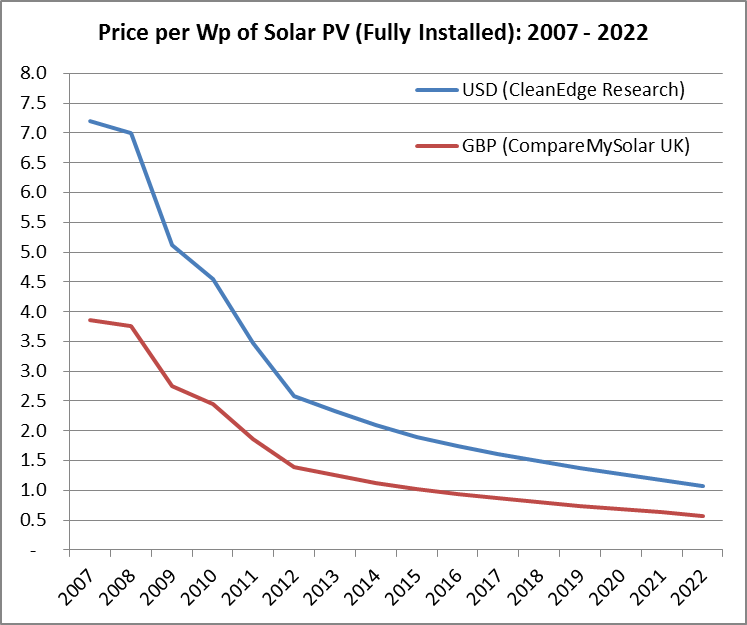
With the price for solar-panels falling exponentially (1/2 every ~6 years), north facing tiles even in the most extreme examples will become profitable in a few decades or less.
Good rule of thumb is that the best production per panel ratio to get the most utility consumption offset (so you drop to the lowest tier) will return the most savings.
Shaded or North facing panels in the northern hemisphere are almost never worth it. Put what you can on the south and look into a better AC unit, new windows, LEDs, and insulation first.
You've been downvoted but I also noticed the "northern-hemispherism" (to coin a word) in the title. It does get a bit tedious for those of us who live in the southern hemisphere.
It’s not just the charts, “In Minneapolis, a 10/12 pitched roof that is perfectly north-south will have a 57% penalty between the south-facing and north-facing modules.”
Really, you should not complain if you’re badly skimming an article.
If he gave some context in the beginning of the article where he exclaimed "Not great, to be sure, but probably not as bad as you might expect!" to say "But a 2/12 roof is very shallow" (and indeed is the minimum pitch suitable for shingles), I might agree.
But you shouldn't have to get half way into the article before you find out that he chose the absolute best case for his example and you're not likely to see the same results in the real world.
The very next paragraph starts with ‘The tilt of the roof matters a great deal.’ Including a much worse example at 29% worse, but also a better one 1:12 which are not uncommon for that area. He then adds ordination of the building, and latitude as further examples.
Really, if he had started by showing a huge chart it would have been gibberish to most people.
This probably applies more to homes with an East to West facing pitch, but I find it really odd that it isn't standard issue to have a track system that moves the solar panels from one side of the roof to the other. A simple track and something basic like a garage door motor would allow the panels to be in a more optimal position throughout the day.
Slightly off topic, but why is there so much discussion about fixed rooftop solar compared to a ground based system with tracking? Seems to me a ground based system would be easier and safer to set up, easier to keep clean, and easier to keep in an optimal position, even if it didn't have tracking. Why have this tight coupling to the roofing system?
It develops that tracking systems are expensive, heavy, and take up a lot of space.
In fact, so much so that the tracking systems rarely make sense with modern panels. You would usually be better off spending the money, weight, and space on more fixed panels than messing with the tracking systems.
That's disappointing. It's too bad the tracking systems are such a burden.
But what about a simple wooden structure to hold fixed panels oriented optimally? That's a few thousand dollars at most, for a twenty to sixty percent efficiency improvement. It would kill me to mount panels facing North at a 45deg angle.
For urban residential I wouldn’t give up any area of my small plot of land even if it provided all my electricity and the installation was given to me for free.
Okay, but in the suburbs I see every house with hundreds of square feet of unused lawn, which is useless at best, and and ecological disaster at worst [1]
Isn’t the point of a lawn that it’s “unused” space? That’s where kids can play soccer and all that.
I have 10k square feet total plot, most of it not occupied by garden, buildings and would still not prefer to have panels there rather than on the roof where the space is “free” because I can’t use it for anything else.
Even at 60 degs north lots of people do have solar on the roof here (but haven’t seen any north facing)
Oh, children actually play outside on the lawn in your area; that's wonderful.
But using an inefficient roof angle isn't free. That loss of output has a cost. I would think that in some cases it is a significant cost, so I'm just surprised that ground based mounting is so rarely mentioned.
A ground based two axis tracking mount that can take the wind loading of six 360W 72-cell (2.0 x 1.0 meter each) panels costs more than the panels. Foundation, concrete, pole, mechanism, etc.
It is much more economical to just buy more panels and mount them at a fixed angle.
Expanding on that, built up areas are where the demand and grid already exists, but not necessarily the clear space. Little added transmission capacity is needed.
In a neighborhood in my city where a few large electric users have expanded, the utility has been subsidizing rooftop panels for residential users to minimize summer peaks and avoid having to upgrade the old undersized grid. So far it has worked pretty well - peaks usually line up with the hottest sunniest days.


That's what lead me to this particular article, which examines the efficiency of putting panels on north facing roofs.
I explored the vertical panel idea in a blog post last year: http://curtisb.posthaven.com/the-solar-garage-door. I don't know if that idea would work, but I was trying to imagine an application of the idea so absurdly simple that a startup could easily use it to bootstrap into a more lucrative market.