While in university I took linear algebra and didn't understand much of it, especially on a deeper level. Then I stumbled upon Gilbert Strang's linear algebra lectures and watched them... After watching his explanations I got all of it and actually understood things at a much higher level. It was a sweet revelation and today I find linear algebra beautiful. I highly recommend watching his linear algebra lectures: http://ocw.mit.edu/courses/mathematics/18-06-linear-algebra-...
Edit: I also find linear algebra to be useful and much more important for programming/CS than calculus, especially for implementing various ranking algorithms (e.g. Google's PageRank algorithm is mostly rooted in linear algebra).
I've to second that, it was a bit slow at times but overall pretty decent and far better than my university class.
Is there anything similar for Analysis I and/or II?
Thanks for reminding me of those lecture videos. I have a linear algebra test tomorrow, Wednesday, and these videos will certainly help me study for it.
wow, GS is the man! he still looks remarkably similar to the way he did almost 10 years ago when i took his class.
EDIT (to make this post not as content-free): Prof. Strang keeps the hope alive that some distinguished faculty in top research universities still place an emphasis on great undergraduate teaching
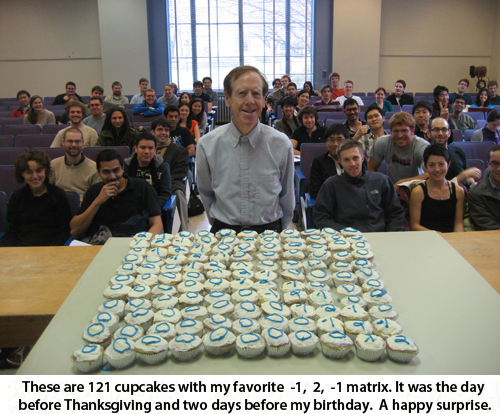
No idea actually, but it was something he mentioned the first day of class. He introduced it as "K, the second difference matrix, and my favorite". That was good enough for us.
I struggled with high school calculus. I just couldn't wrap my head around the concept. My teacher kept making noises about "rate of change" but it made no sense. Luckily for me, I was taking physics at the same time, and we ran an experiment to calculate acceleration due to gravity.
So we ran the experiment with a weight and a ticker tape and a little hole punch tool and we got these data sets measuring the distance between each consecutive hole on the tape. Plotting distance against time on a graph, we produced a curve somewhat reminiscent of a y = x^2 function.
Then, given d2, d1, t2 and t1, we were able to calculate a set of velocities between each point. Plotting velocity against time on a graph, we produced a sloped line somewhat reminiscent of a y = 2x function.
And then, of course, given v2, v1, t2 and t1, we were able to calculate a set of acceleration rates between each point. Plotting acceleration against time on a graph, we produced a horizontal line somewhat reminiscent of a y = 2 function.
Then it hit me. Looking at the three graphs, in a flash I suddenly understood exactly what "rate of change" meant. I understood why d(x^2) = 2x, and why d(2x) = 2. Calculus made perfect sense, and I plowed through all the exercises that had plagued me since the start of the year.
So when I clicked on the first video in this OCW set [1] and watched Professor Strang put distance/speed and height/slope side by side as his two canonical examples, a big smile spread across my face.
I have been intermittently trying to teach my 6 year old niece calculus graphically. She can visually tell what the slope of the curve is and filling in the area under the curve is, well child's play. :-)
I believe there was some work done using small talk to teach children physics where they were able to do quite complex things without having to understand calculus... can't quite find the link right now.
Try looking at the constructionist articles, specially Papert's works, as there are a lot of them online[1].
Basically, the idea is that you can introduce deep mathematical concepts very early by adopting a more intuitive media. Also, take a look at McLuhan[2] to understand how the media shapes the message if you really want to go deep into it.
There is another post in response to this comment containing four full paragraphs explaining why Newton wasn't succinct, but the post is now marked as dead. If anyone familiar with the Leibniz vs Newton history wants to turn showdead on in their HN settings and read the post, I'd appreciate commentary on its accuracy and origins (and, perhaps, an explanation of why it was killed).
Based on my reading of Jim Gleick's biography Isaac Newton and my background as a theoretical physicist, I believe your comment is essentially accurate. In particular, Newton's desire to connect calculus with Euclidean geometry is certainly correct. As you note, the Principia eschews calculus in favor of geometric arguments: Newton used calculus for his private calculations and then translated the results into more conventional geometry to meet his audience's expectations. I'm not sure about the religious aspect, but Newton was privately a heretic (he believed in a unitary god—an awkward belief for a professor at Trinity College), so he definitely knew how to placate the religious authorities. Finally, the Leibniz anecdote is new to me, but it sounds plausible.
In any case, I don't think your comment should have been killed.
I'll taks a stab at guessing the killing: parent^2 was being facetious and a lengty serious answer was not considered appropriate.
I am mostly guessing though, and I don't think it should have been killed.
   Anybody have insight into how to actualize these
   nuggets into some semblance of a self-learning course?
Buy Calculus by Micheal Spivak. Solve at least one problem every day. Make it ritual and a daily requirement. Watch MIT lectures for corresponding chapter you are on.
To learn this, don't trouble over the path and reason at present. Buy the book and start. Right now.
Strang's Calculus book is available for free. Is the Spivak book a much better resource? I'm not familiar with either one, but I've seen both recommended before.
Haven't read his calculus book, but Strang's linear algebra book is the best math book I've ever read. It's actually readable! Certain chapters are available on line. Based on it I would definitely try his Calculus book if I needed one.
Spivak's book is more of an analysis text. If you are interested in mathematics, go with Spivak. If you're more interested in engineering or physics, you may be happier with Strang.
The key step with math is to do the exercises. Videos can get you interested, and help explain what you read, but that's it. In the end, you need a textbook, judged according to the quality of its exercises and then a maybe a study partner to make it fun and maintain commitment.
Prof. Gilbert Strang is a great teacher — I am amazed at how well he explains complex concepts in a simple way.
Does anybody know of a similar resource on probability, especially the Bayesian approach? All I could find were lectures of significantly worse quality than prof. Strang's teachings.
Anyone happen to know a good resource that takes a single problem to show how Geometry, Algebra, and Calculus can each be used to solve it? I'm hoping for something that can quickly demonstrate how each builds on the other to get better and faster results.
I haven't watched the videos, but be wary of anything that claims to simplify math into some awesomely brief time frame. In my experience you come away with a conceptual understanding, but no ability to apply it. Convolution, for example. 99% of pages on convolution spend a long time describing what it represents, and using nifty animations to show you, but you still come away unable to solve all but the most basic problems.


Edit: I also find linear algebra to be useful and much more important for programming/CS than calculus, especially for implementing various ranking algorithms (e.g. Google's PageRank algorithm is mostly rooted in linear algebra).