The fact that Dropbox's revenue is well above Box's if the rumors in the article are true is a great positive sign. As is being cash flow positive which would indicate that if they are burning cash it isn't at the rate of 2x revenue that Box has been a victim of.
However, the vision they are selling will not come to pass. That of them being a collaborative platform. Google docs, slack, and a myriad of other tools have already taken that place and there isn't a large enough disruption in Dropbox to unseat that.
In the meantime Dropbox's core offering of syncing and sharing files seamlessly as well as providing more security minded options for businesses is something that no one else has quite gotten right.
Box targeted the high-end enterprise users and Dropbox ceded that market to them rather early on. But the massive number of individual users coupled with SMBs that do not need the complexity that Box entails is a large market. The only question is are those two markets combined larger than the enterprise market that Box is chasing.
According to the revenue reported it seems that currently on the revenue side it is.
And given that investors do value profitability and with only a 200 sales person team their burn should be within controllable limits should make them overall both on the profitability and revenue side more attractive than Box.
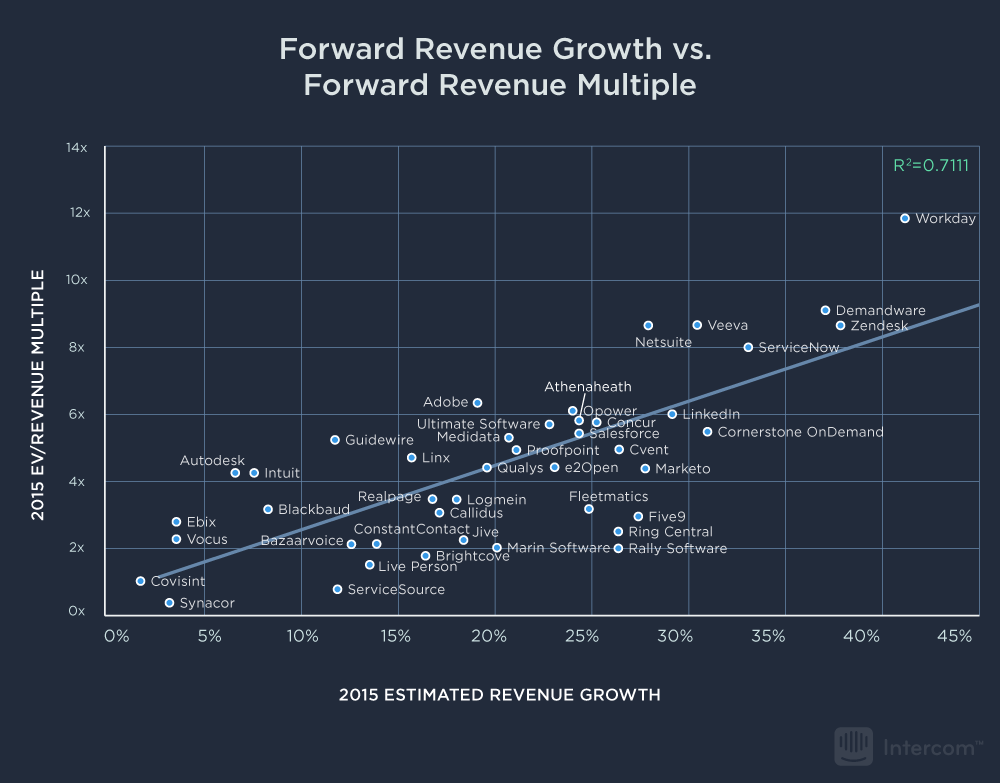
However if they grew revenue from $400 -> $750 they simply do not have the growth trajectory that gets Wall St excited because due to their maturity and larger revenue you get a more consistent view point into their future growth.
Then again if they are compared more to Atlassian that is trading at 10x revenue then they certainly maybe get justified in their close to $10B private valuation.
Shame, too, as it was the Dropbox feature I used the most. I hate having to link people to the clunky, slow-to-load viewer interface that Dropbox presents when you make a share link. I also don't want comments! (which always takes up an entire sidebar and has to be manually closed)
| In the meantime Dropbox's core offering of syncing and sharing files seamlessly as well as providing more security minded options for businesses is something that no one else has quite gotten right.
There is absolutely no mention whatsoever neither in the article, nor in your analysis above about Owncloud.
Owncloud (or any OSS fork thereof) is an existential threat to Dropbox's core offering: while the consumer side is not yet price-competative, it can already be one-click deployed by many VPS providers. And the business case for hosting mission-critical data onsite, or at least own leased equipment & encryption is strong, and enjoys economies of scale.
I went on a little adventure the other week of setting up my own NAS server, and checked out Owncloud and competitors. Even ignoring issues like feature parity and third-party app integration, I think the setup costs of something like this are still way too high for consumers. While VPS providers may make this process easier (even deploying complete Dropbox clones with no tech knowledge required), they'd still be doing it at a significant disadvantage to Dropbox's scale and expertise. It was clear to me very quickly just how much work has gone into giving Dropbox the level of polish it has. Note that this doesn't even address other competitive moats such as brand recognition and distribution partnerships.
Not saying that Dropbox doesn't face business risks -- but I think the open-source alternatives will not be the biggest risk ulttimately in the mainstream market.
I do think they will face margin pressures as long as Google/MSFT/Apple/Amazon believe this to be too important of a market to cede to Dropbox.
though things like Owncloud help make it easier for self hosting, many enterprises will still prefer to opt for something like Dropbox because Operations are hard!
Why does anyone use hosted travis CI despite being able to run it ourselves? Why do people use google apps instead of hosting their own mail servers? Because instead of having your employees do something they're not necessarily good at, you will pay experts to do something they are (supposedly) good at for a fraction of the price.
You know Apple already offers that, right? I don't want to sound like an Apple shill so I will avoid naming the feature; apple is big enough that if they can't get the word out it's not my problem!
Nope.. I can't directly iMessage a large video or photo set. Also photo stream requires syncing photos on multiple devices.. what we really need is upload to the cloud and forget (or at least browse on demand) and not require local storage... This is really only a problem for the lower end iPhones.. but it sucks.
I have to second this. It's amazing how right Google has gotten the photo experience, incrementally, over the past few years. Meanwhile, photo on iOS have essentially stood still during that time.
> In the meantime Dropbox's core offering of syncing and sharing files seamlessly as well as providing more security minded options for businesses is something that no one else has quite gotten right.
I'd argue that Dropbox haven't quite gotten it right either: to my knowledge, they still don't support client-side encryption, which is IMHO non-negotiable in any cloud storage product.
I really respect Dropbox's ease-of-use, but I think at this stage in history it's outright irresponsible to offer a cloud service in which one can see one's customers' data.
> As is being cash flow positive which would indicate that if they are burning cash it isn't at the rate of 2x revenue that Box has been a victim of.
I'm probably inferring something you didn't mean here. By "if they are burning cash" did you mean "yes they're wasting money, but still less than they're making so that's great"
Or is it possible to be "cash flow positive" while spending >1x revenue?
You are correct and inferring the right thing, that even if they are burning cash it isn't substantial because you can't be cash flow positive and burn >1x revenue.
If you can open items from Dropbox and edit them directly, there might be hope for the product. Saving even one click between Dropbox and my current collaborative tool (Google Docs, Slack, etc) can be meaningful.
I talked to a friend just before Christmas whose firm made a good portion of their returns on the insight that VC firms, IPO participants and the market in general all have gaps in how they evaluate the worth of a company and the fact that this gap has grown significantly in the past 5 years.
Previously, companies went public much sooner and you could expect a match, not an exact one, but in the same ball park, between the VC valuation and wall street valuations. This helped lead to rising share prices after the IPO.
Now with longer gestation periods leading to more fund raises, the VC's get paid, but its the IPO participants and the employee's who get screwed. Once a company is public its GAAP that matters and GAAP analysis usually assigns a revenue multiple to a company that is based on its sector and assumed growth. This multiple is almost always much smaller than what the company's publicly stated valuation.
This leads to a bunch of broken IPO's as companies stretch to IPO at a certain price to meet mezzanine level funding requirements. If you can get borrow, almost certainly dependent on how much you pay on commissions to brokers, then atleast up until this year you could have made decent money shorting most tech IPO's, most other industries don't yet suffer from a phobia of becoming public.
> GAAP analysis usually assigns a revenue multiple to a company that is based on its sector and assumed growth
GAAP is an accounting framework [1]. It defines, for example, how one may and may not recognise revenues [2].
GAAP does not tell investors how to value a company. "GAAP Analysis" isn't a thing (gap analysis is [3], but that's a management tool).
That said, yes, public-company investors tend to look at Revenue, EBITDA or P/E multiples. But so do late-stage VCs. Both ascribe high valuations when expected growth provides for it, e.g. Amazon or Tesla or Uber.
A multiple gap has emerged between the late-stage private company market (at least at the top end) and comptable public companies. But it has nothing to do with "GAAP analysis" (which isn't a thing) or mezzanine funding (which most VC-backed companies don't take on).
It's pretty clear that what he means by "GAAP analysis" is "valuation based on GAAP revenue", as opposed to "valuation based on bullshit cooked revenue metrics", like the fanciful definitions that Groupon tried to convince everyone about.
I've gone through 6 startup IPOs since 1999 in the valley, and have watched as it went from a way to reward employees to a whole lot of voodoo bullshit. I'm a little stunned when I see people still talking about the startups they work for and possibly making it big - that doesn't happen anymore. You are being lied to.
if the founder(s) of the company got really rich, but the company is still owned by VCs, there is almost definitely "voodoo bullshit" going on.
it's customary to take some money to alleviate the everyday financial stresses of life and to maybe buy a decent house because people have families, but the original intent behind the IPO was designed to align everyone's incentives. when they aren't aligned i.e. when there is a super-class of owners that already cashed out, it's going to end badly for the people who aren't in control.
everyone who got in early is already rich or completely exited, and more idiots keep piling onto the funding rounds... hmm... what does that sound like?
Genuinely curious what you think has changed. Liquidity events are certainly much later than they used to be. What else has had negative effects? Late stage ratchet terms?
VCs don't get to take their profits until after the company exits. If they invest at a high valuation and then it IPOs at some lower price, there is no gain and the VC gets zero carry.
That's not true with liquidation preferences? The reported valuations in the press that come out after some random funding round are calculated with simple arithmetic but don't take into account the preferences...
You would have to be an idiot at this point to accept options/stock as an employee for an SF start up. They'll squeeze the options until you make nothing from them.
Dropbox is anti-SaaS -- it expects users will have more 'files' and use more storage, but users are actually moving to SaaS services where the concept of files just doesn't exist.
Many usages from hackernews readers are too techy and not for consumers -- like cross-platform or using as git repo. iCloud, Google Photos, Facebook and YouTube took majority of consumer storage needs aka large photos and videos.
I think enterprise market is their best bet but Box /Google/Microsoft are dominating in this space.
Dropbox is one of those products that is just a pleasure to use (like Stripe). Sync works seamlessly. I've tried all other alternatives and gotten back to being a paid customer of Dropbox. I think it also boils down to most of your employees being passionate, smart folks from MIT, CMU and the like. Good luck to them with the IPO.
I was initially ecstatic about Dropbox, but they seem to be at best stagnant in terms of functionality.
It was my solution for having access to all my photos on all devices, but then they canceled Carousel with the promise that its functionality would be rolled into the main app. That hasn't happened. The photos feature on iOS is pathetically limited, with slow loading times, no way to organize photos (you can't even access albums you create on desktop), and inadequate sync functionality. The web client isn't much better. What exactly are all those engineers doing with their time?
I am increasingly wary of Google, and do not wish to give them all of my photos. What solutions am I left with? I don't feel like my asks are a tall order for a company of Dropbox's size. I basically want what the old Picasa desktop app provided, except synchronized between all my devices.
I can't possibly be the only one with this problem: an ever-growing library of photos and videos, scattered across various phones, DSLRs and computers with the need to organize them and share them easily. I am happy to pay.
For your usecase, Prime Photos [1] from Amazon, where they meld the traditional album and folder metaphors with auto-classifying ML -- the latter which you can luckily turn off if it creeps you out, unlike with Google.
But this is an under-served market and many people would pay to some paltry amount a month to have their family photos (or professional photographs) kept safe in the Cloud. Unfortunately most cloud storage providers are chasing the (presumably much more lucrative) enterprise market with document-editing and office-y features.
This looks interesting, I wasn't aware Amazon had entered this space. I'm not sure I trust Amazon either, but at least they're explicit in their desire to take my money in exchange for products and services.
Edit: it doesn't appear to provide any ability to organize photos yourself?
For the time being you can freely switch two different interfaces for the same backend: Prime Photos and Amazon Drive [1]. It's clunky. Cloud Drive was their first pass, Photos is their second and is barely a few months old, and I'm not whether the old interface will be disabled for Photos users at some point.
The uncertainty about the product direction is a bit off-putting, but it works decently well for my use-case [2], even if now you can't get that particular tier without Prime.
What are your recommendations for a fast, intuitive, portable third-party solution that uses Dropbox as a data store for my use case?
Edit: While separating these concerns (storage and presentation) is a solid software engineering approach, without open standards it would seem to just add additional layers of vendor lock-in and brittleness. Syncing to local storage is a non-starter for mobile.
I'm satisfied with Dropbox, because it does what it advertises: it syncs files between computers without getting in the way. I would be very worried if it weren't stagnant in terms of functionality, because change for change's sake is the path to bloated crapware.
If you want your photos on all devices, Dropbox does this for you. If you want software to look at the photos that is a different task and should be accomplished by a different piece of software.
People say this, but i actually hate it. Every time i use it i get confused, it's UI is slow and weird. I prefer Google Drive, but I might be a weird user.
Why are you using the web UI? Dropbox is at its best as just a folder on your hard drive that works like any other, except it effectively exists simultaneously on all your devices.
I'm going to guess that the person also uses Google docs and or slides which is mostly web-based -- yes you can download it for offline use but that's a hassle.
I use both the sync client and the web app (depends on the situation). The web app for the google suite is just so much better, the Dropbox website is painful. The sync client for Dropbox I used to find slightly better, but it's not better enough to justify the massive license costs of Dropbox in comparison to google drive. All in all, each to their own!
I generally like Dropbox, but they made a change which has really annoyed me and made me like them much less. You used to be able to have a folder of html files in your public folder, index them with another html file, and then generate a bit.ly URL pointing to the index file. Boom, instant website for sharing things with a handful of people. They deprecated that funcionality and now several sites I made like that don't work, which is incredibly annoying. Not sure what that got that besides alienating power users.
This is the main reason I'm considering my Pro subscription. As a power user not using the collaboration or business features, having a very easy way to get a public, no web takeover link via the public folder was worth the cost (in addition to symlink syncing folders across computers). It truly was a killer feature.
We’re always looking to improve the Dropbox sharing experience. The Public folder was the first sharing method we introduced, and since then, we’ve built even better ways for you to share securely and work together with your team.
As a result, we’ll soon be ending support for the Public folder. Dropbox Pro users will be able to use the Public folder until September 1, 2017. After that date the files in your Public folder will become private, and links to these files will be deactivated. Your files will remain safe in Dropbox.
If you’d like to keep sharing files in your Public folder, you can create new shared links. Just make sure to send the new URLs to your collaborators.
Double-speaking crap. They've broken literally thousands of links I've posted around the Internet since I started using Dropbox. I pay for Dropbox Pro specifically to have more space in my Public folder. And they chose to be pretty jerkish about it, to boot. Gross.
Unfortunately for me, Dropbox has never been a pleasure as an OSX user. The number of times dropbox just spins eating up cpu while trying to index all my files has forced me to uninstall it. Also since my company uses it for all client work, and they still haven't figured out selective sync (https://www.dropboxforum.com/t5/Dropbox/Stop-auto-inheriting...) I was occasionally finding all my broadband and space getting eaten up by a new client folder.
I passed when I learned that in order to sync target directories they all had to be moved and live under the /Dropbox namespace, and that I would now be working within that namespace for my various projects. No thanks. That was a while ago - maybe they are different now?
Dropbox does not cooperate well with symlinks. For instance, if you create a symlink in your Dropbox folder to My Documents on Windows, the Dropbox folder will duplicate the My Documents files. Takes up twice the space.
Syncing outside folders to Dropbox used to be such a pain because symlinks/junctions don't sync changes as they happen (you need to restart Dropbox each time in order for it to sync changes) so that's why we built Boxifier. Disclaimer: I am one of the founders.
I hope their IPO fails spectacularly for the singular reason that they have a board member who supports warrentless surveillance [1].
This seems like a huge issue for a company that is entrusted with user data. If Dropbox continues to be successful, their support of warrentless surveillance will become the norm. I don't use their service. If you value the security and privacy of your data they seem like a poor choice.
The product works well for consumer use cases. However, when it comes to business use their technology isn't there yet. The upcoming Project Infinite will however be a step forward.
Being the one cloud service that sync across Linux, Windows, OS X with a native client, Dropbox is the service I'd like to give money for about 100GB of space for a couple of bucks a month, but I just don't need 1TB for $10 a month. So instead I use Google and wait in vain for a native Linux client that's probably never coming.
IMO, 1TB is completly reasonble. You can get ~10 GB of storage several places for free which covers most things and minmaxing 2-3$ per month is generally a waste of time.
What a lot of us want is more granularity. I'm totally fine with their per-GB pricing, but if I (as a personal user) want more than 1TB, it is literally impossible to buy it from Dropbox. I would have to upgrade to a business plan, which makes no sense as I'm not a business.
Basically, there are only 3 Dropbox tiers: 0, 1TB, or infinity.
Dropbox is not charging per GB because they don't really pay per GB. Their model depends on people not having a lot of original content so you might have some home movies or whatnot but if you upload 500GB the bulk of that is probably 3rd party games / Movies etc.
So really, most people are buying <30 GB of storage + a lot of bandwidth and a decent UI.
With that in mind the number of people with more than 1TB to store either need a streaming service or actually have original content which breaks their model.
I gave up and just started using AWS S3 directly. I use a few GB, pay a few pennies for storage, a few more pennies for bandwidth if I'm moving stuff around, and that's it. I've never paid more than $10/month, and it's usually under $1/month.
that defeats the whole purpose of dropbox though. You can have a cheap ftp server for $10/year if you look hard enough.
But the argument for dropbox is that you have a client for almost every platform you can use. With S3 you'll have to use a 3rd-party software, which might not function properly.
What client(s) do you use to access your bucket? What kind of sharing features do they have? Is there a web frontend? And how do you deal with eventual consistency?
As a linux user I use, Resilio Sync (formely Bittorrent Sync) with a VPS on serverhub.com . I pay $15 a year per 125 GB. It might not be as good as dropbox but the price worth it. I can even store the files encrypted. (I am not affiliated with neither Resilio sync or serverhub, just a happy user)
Was Dropbox more attractive to you when it offered 100GB storage since you would have used more of it?
Why do you consider Linux support worth $0 (since you want to switch from one $1.99/mo service to another) instead of a number between $24/year and $120/year?
This is the exact reason i didn't switch to a pro yet. I love dropbox and all the syncing, but give me a plan below $5 with a relative storage. Google Drive gives 100GB at $2, that would be an amazing start for Dropbox.
That is not going to happen. Google can sell Google Drive space at a loss, since they have other sources of income (ads, Google Apps subscriptions, etc.). In fact, nothing from Google's terms holds them from mining your Google Drive data for ads (unless you are using Google Apps for Work).
For Dropbox, storage is the only source of income. Most of their income comes from people like me who are modest users ( < 100GB, not a lot of transfer).
Offering intermediate plans would make nearly all users high-loss users.
(I also can't understand why people are expecting to pay only $2 per month for 100GB of highly redundant storage with a top-notch client.)
> Go to site
> $29
> Not your currency?
> select €
> €29
> Select £
> £29
Even going past the fact that OverGrive is $5, I won't support companies that think currency conversion is a way to leech more money from non-US customers. Yeah yeah taxes, but then the £ price should be around £27 and not £29. Its crystal clear what they're doing.
> In addition to selling utilities to keep digital files safe and accessible, Dropbox intends to offer software that businesspeople use for hours each day to create content and get work done.
Aaaaagghh!!!
Just... no. Dropbox used to do one thing well (modulo creepy stuff [1]): sync a directory across multiple computers. This wasn't so hard to do, but shockingly, Apple and Google didn't just implement this feature and make them obsolete. They could have been satisfied with owning that market, but now they want to create yet another office suite? Ugh...
No, everyone does not do that and the rest of the world does not work that way. This train of thought is specific to capitalism (not to be confused with free market). Most large companies do a few things well and everything else mediocre or poorly. Most small companies do a few things well and everything else poorly.
The difference is a small company recognizes it can't afford to do those things poorly and won't pursue it. Large companies will keep dumping money into bad, poorly planned products. See Apple and cloud, Google and everything not Pagerank, Microsoft and mobile.
The world has more small companies than large ones.
I'd be very surprised if Dropbox manages to IPO at $10B valuation. The growth simply isn't there. They're big on platforms and markets with no growth but they're getting killed in growth markets. E.g. my cloud storage startup Degoo recently surpassed Dropbox on the Android grossing rank in India (http://imgur.com/HsII1KK) and we're only 5 people.
Their revenue according to the article is $750 million a year. You really think that their P/E ratio is less than 13? Most tech companies trade at a P/E between 25 and 30 these days. I wouldn't be surprised if DropBox's valuation was around $20B.
Seems that you are correct - earnings refers to profit (bottom line) rather than reveneu (top line). Thanks!
That being the case, DropBox probably isn't profitable yet which would throw their P/E through the roof and make that a useless metric.
Box is already public and it has revenue around $300 million and a valuation of ~$1.9B. DropBox will probably get a better revenue multiplier since their customer acquisition cost is lower than and their overall network effects and future outlook is better than Box. I'd place DropBox at a ~$6B valuation. Hopefully their revenue grows enough between now and IPO to support something closer to $10 or $12B.
I'm slightly shocked that tech-types who in general seem to be against mass state sponsored surveillance continue to support Dropbox. Dropbox appointed Condoleezza Rice to their board. Rice supports warrentless surveillance [1]. They've made no moves to encrypt data service side.
I hope their IPO fails spectacularly so that support of warrentless surveillance does not become the norm in tech companies.
I think most people recognize that they don't necessarily agree with everyone, especially when it comes to politics, and that refusing to work with people because you dislike their politics is, in general, not a smart thing to do. Not to mention not supporting companies because one of their board members takes a position you dislike on an issue.
I'm happy to work with people whom I disagree with politically. But if you're concerned about privacy, giving all your files unencrypted to a company that is uninterested in your privacy (as demonstrated by their board) is just bonkers.
But it's quite clear that Rice's value to Dropbox is based around her background in politics.
And in particular, her background in politics is one that is diametrically opposed to what Dropbox should be providing its users. A secure, private storage service.
There is a difference between disagreeing with positions and judging past actions. Rice didn't have fringe opinions that she occasionally ranted about on Facebook. The stuff on drop-dropbox.com was her full-time job, her life's work.
> refusing to work with people because you dislike their politics is, in general, not a smart thing to do
Like vaccinations, it can be effective when most people do it. I think (hope) many companies would have declined the chance to work with her.
It's very clear from that page that the data is sometimes transmitted unencrypted.
It's also clear that if it's encrypted server-side it's encrypted with a key known to dropbox (which in my opinion makes the encryption meaningless).
So, technically it's possible that my statement was slightly misleading. It may be encrypted.
But the conclusion is, they have access to all your data. It would be available under warrentless surveillance programs, or potentially to attackers in general.
It would certainly be interesting to know how much space is saved through deduplication.
However, my guess is that it's very unlikely to make the difference between a viable and a non-viable company. Particularly as they had a viable business when storing data on S3 [1]. I'd expect the cost savings of moving from S3 to their own hosted storage to be far greater than those earned through deduplication.
Adding secure client side encryption would quite much limit any new services they could add. No indexing on server side, no web based document editing. Deduplication would become either impossible or much more difficult. This might also cause problems on the user experience side, for example password resets would not work - if you forget password, data is gone for ever. Organizational accounts and file sharing would be harder to implement. In order to really prevent snooping, they would also have to take away the pretty well working auto update system (otherwise they could just push an update that sends your password to them).
I think this is just a business decision. Dropbox does not want to be the simple bit-pipe that is used to sync stuff between your computers. They want to provide more advanced services, because they believe that is where the money is.
I would agree that I think this is mostly a business decision. And it seems to be the same business decision that almost every player in this space has made.
But it relies on the user trusting the vendor with their data. The user can't audit Dropboxes internal systems. They can't rely on the fact that security researchers will audit the client, and ensure that data is transmitted securely.
So it comes down to trust. I can't really see how I can trust dropbox when they think having board members who advocate warrantless surveillance is reasonable.
They chose a board member who is in favor of providing their users data, without the need for a warrant.
In contrast, Apple have made a stand against government access to their users data outside of legal requirements. Their service has similar issues, but I'd be more likely to place my trust in Apple than Dropbox because they have some track record of fighting back.
Ideally, what I'd like to see is optional client-side encryption that was externally audited. Unfortunately I think it's a feature that most users don't see as critical.
Warrants are only required in some cases of surveillance. Those who are not U.S. persons do not have a constitutional right to a warrant before being surveilled. Public information does not require a warrant (e.g. the government does not require a warrant to open a phone book). Third parties may volunteer information without a warrant. Items crossing a national border — including communications crossing a national border — do not require a warrant.
There are plenty of constitutional, legal warrantless searches. You may not like some or all of those; I may not like some of those. But neither you nor I are the dictator of the Constitution or the law.
As a former Dropbox user, I can't imagine investing in them. For me, their plans are just way out of line with regard to pricing. So out of line that I'm going to go to the trouble of moving all of my stuff to Google Drive or OneDrive. And I hate their ransom policy of giving you free space for a while due to phone promotions or whatever and then taking it away. You are screwed and can't access your own stuff until you pay the ransom. I just don't think a company formed on those sorts of policies and pricing strategies is a good investment.
I agree. Dropbox are massively more expensive than competitors like Google Drive. I stopped using Dropbox years ago when I realised that shared files and folders take up quota for ALL people that have access to it. This is absurd, and is a terrible experience when you're trying to share something with someone and they then have to upgrade their account.
I used to love Dropbox, but the pricing model is terrible.
My primary use case for Dropbox, actually, is getting videos onto my iPhone. You can't simply drag and drop a video file into the phone as a mass storage device. With ITunes, the sync feature purportedly sync the video to the device, and consumes space accordingly, but there's no way to access the video on the device. It's actually way faster for me to upload a video to Dropbox from my computer, and download the video on the Dropbox app into my photos. The video quality is excellent, too!
This drives me crazy too and it is embarassing that on iOS after ten versions we still can't easily add a video media file easily.
When I am short on time or not on my personal Mac I airdrop a video file to the iPhone/iPad. Sadly it ends up in the PHOTOS sphere, not the Videos app/internal directory. So the play controls are odd and it does not continue playing when exiting out. But it works. Kind of.
I'm moving away from Dropbox as a consumer. Google Photos [1] for jpg and video; Prime Photos [2] for raw and jpg. Uploading raw and jpg to google photos causes a lot of duplicates, plus it gets recompressed.
I predict the quality of free Dropbox service will go down (or not significantly improve) after they become publicly-traded, similar to what happened to Facebook, since the stockholders will force them to monetize the free accounts. They why I avoid using free but proprietary services.
The quality of the Pro service already went down considerably: it has advertisement for the business version in all places. I guess that they want to drive up value for the IPO.
I just don't understand why they are annoying Pro users. Not every Pro user uses Dropbox for company work. Not every Pro user is in a company/organization that will ever switch to Dropbox.
Maybe they annoy the pro users with ads for the business version because they know the pro users have money and are willing to pay...somewhat targeted advertising.
That eliminates a rather large fraction of the most popular online services, including Twitter, Skype, Spotify, Google Search, Square Cash, OKCupid, GitHub, and so on. Oh well, there's always Hacker News. Oops, Y Combinator owns that.
When they (finally) moved off S3 to their own setup it really said to me that they're going to IPO. Sure, a lot of companies the size of Dropbox (in terms of rev) do it, but a lot of those companies don't have profit margins that are directly related to S3.
I've always wondered why BOX did their IPO before Dropbox. I know Box is two years older but it seems like age is only a relative determinant in IPO timing (FB IPO at 8 years, Google 6 years...).
I wonder why we haven't seen good open-source imitations of Dropbox yet, and why there isn't a good open protocol for file sharing. The last such protocol I've heard of is WebDAV, but it seemed to have been neglected by OS implementers (Apple's implementation was particularly bad). Also WebDAV was missing many modern features.
I agree, and by no means is it a replacement, but https://syncthing.net is pretty damn interesting if you want to control your own data. https://www.syncany.org [now abandonded] was a cool twist on the idea using cloud storage in a secure way.
I've been using SyncThing for a few years now and I'm mildly surprised that it is not more popular.
Though every time they release a new major version it breaks compatibility with the older major versions and this happens quite often. They need to stop doing that if they want mainstream adoption.
I think SyncThing also has the wrong model for mainstream adoption: you have to fiddle with host keys that you need to add to every peer. Bittorrent/Resilio Sync's model of using shared RW/RO/encrypted keys per share is much more intuitive.
There seems to be one open source project that aims to implement Resilio Sync's model:
File sync is one of those things that is easy to get 90% right and exponentially harder to get 99% right; there are a ton of edge cases especially when you introduce cross-platform and mobile apps and all that fun stuff.
It's actually a true bonafide distributed systems problem, where the implementation and service matter just as much as the specification.
The value that Dropbox provides isn't the sharing, nor the protocol - it's the failure-free merging algorithm (I intentionally said "merging" not "syncing"). The magic is what happens locally - not on the network.
Nope (though I'd love that). By "merging" I mean things like folder trees. But Dropbox gets so many nice details right that competitors and homegrown solutions tend not to think of:
* When syncing a folder tree (uploading or downloading), it transfers files smallest to largest (globally across all files queuing to sync, regardless of folder). This simple algorithm is remarkably close to optimal behavior.
* When modifying a small file while larger ones are syncing, the small file immediately cuts to the front of the line (even sub-file). This avoids situations where a large folder uploading or downloading prevents you from getting the utility of the quick syncing of small work files.
* Files deleted from the server or another computer are briefly retained on the client in a special folder before being deleted from local storage so that their contents can be matched to other incoming files. In other words, even for very complex folder move and file rename operations, if the new files contain the same data as the old ones in whatever permutations, the client will sort it all out without re-transferring actual file data.
* There are no data loss holes. All operations are on a files-first basis (not folder-first), and Dropbox will never decide that a file was intended to be deleted unless the client app explicitly observes deletion. You don't need to worry that offline renames or moves, even multiple conflicting ones from different machines will result in deletions when the Dropbox clients go back online.
* "No data loss holes" also applies to conflicts of a single file. If a file is modified in two different ways by offline clients, one file or the other will be renamed to make sure that a modification isn't lost.
* The Dropbox client never gets stuck requiring the user to "resolve conflicts". It picks the sanest thing to do and does it (always observing the "never lose data" principle). Syncing is delightful and never fails, not a chore to be dreaded and carefully planned for with a bunch of "conflict" choices, like all systems prior to Dropbox.
Dropbox was definitely a good product and for the most part it still is. But with Google and Amazon going towards the free unlimited storage plans, I have my doubts on Dropbox from here on out. IPO just looks like a way out to me.
I've been using Dropbox as a real handy remote git host using the fantastic git-remote-dropbox utility. It's really great to create a remote repo right from the command line and immediately push to it without the hassle of going to a site like GH or BB and setting up the repo first and all that jazz. Make DB worth the money I spend (and unlimited private repos, of course, and with easy sharing by many developers with Dropbox's shared folders).
I pay $100/year for Pro. Cheaper and easier to have 1TB of remote storage than SD cards, USB sticks, etc, and no excessive bandwidth charges such that AWS has.
EDIT: I don't care if my files are encrypted.
EDIT 2: Dropbox sync is rock solid. Every experience with the Google Drive sync client has been trash. I can (and do) pay for convenience.
While this is DEFINITELY not a solution, have a look at Insync[0]. It's what a google drive client should be.
(I just use the cloud to sync files and generally as an USB stick of sorts - not a folder where I constantly edit stuff - so I can't vouch for their extreme sync abilities)
1: Trust: Google is primarily in the business of search, and Google Drive is one of many other products that Google has. The company has a history of deleting or ignoring products that are not performing, or even that are performing but not core. Meanwhile Google's core business or searching anything and everything makes their motivations for GDrive suspect. I moved my email from Google long ago for similar reasons.
2: Salience: Dropbox is in the business of providing the Dropbox service - and everything else is non-core. So if I pay for my service at Dropbox I would expect to be more important to them than to Google, who make far more income from advertisers. Meanwhile Google is famous for being hard to do business with for customers of all levels.
3: Simplicty: Dropbox just works, and very elegantly. It's the product of choice for a very large number of people and SMEs and getting it working outside of a corporate network is easy. Meanwhile Google products (and Hangouts is the worst here) are often inaccessibly appalling to operate for people who are not deliberately immersed in the Google ecosystem.
It's not perfect. I would like to see a far higher standard of security from Dropbox, and wish they had not wasted so much effort on non-core functions like photos. This trend appears to be getting worse - with the article stating "Dropbox intends to offer software that businesspeople use for hours each day to create content and get work done."
A lot of non-tech-savvy people use it for pirating stuff. I've seen some people coordinate larger files across it. But for the most part, I haven't seen it out in the wild for a few. That might be because it's use is low, OR that it's so well integrated as people's workflow, it sort has just sunk into the background.
I find Dropbox by far the most straightforward and convenient of the cloud storage providers (DB, Box, iCloud, OneDrive, Google in order of exponentially increasing frustration level). But at the end of the day it's just a feature. I assume they haven't yet gone public because they have been tap dancing hoping to find a way to break out of the feature ghetto.
If there were an easy way to attach to S3, iot devices, etc (credentials management is a pain) they could probably go out on the strength of that.
dropbox lost me when i started to get hyper targeted spam to email addresses i only used for dropbox and haven't used for years. they seem to use a remarkably persistent cookie syncing technology.
DropBox was hacked in 2012 (and all email addresses were leaked)[0], so you might have just been getting spam from regular spammers that got a copy of this list.
I use dropbox with Zotero almost every day. You can get them to play together relatively easily, using Dropbox for syncing pdfs, and your Zotero account for syncing the references. This was my initial motivation for using Zotero, as other reference managers, such as Mendeley, which made not using Mendeley's storage very difficult.
It is very convenient to be able to add references at work, then come home to find it all up to date on my home PC.
Dropbox integration with the camera on my phone is something I also use a lot. Take a photo of something in the lab, it is waiting for me on my PC by the time I am back at my desk.
The only thing that I really find lacking is a linux armhf cli client...


However, the vision they are selling will not come to pass. That of them being a collaborative platform. Google docs, slack, and a myriad of other tools have already taken that place and there isn't a large enough disruption in Dropbox to unseat that.
In the meantime Dropbox's core offering of syncing and sharing files seamlessly as well as providing more security minded options for businesses is something that no one else has quite gotten right.
Box targeted the high-end enterprise users and Dropbox ceded that market to them rather early on. But the massive number of individual users coupled with SMBs that do not need the complexity that Box entails is a large market. The only question is are those two markets combined larger than the enterprise market that Box is chasing.
According to the revenue reported it seems that currently on the revenue side it is.
And given that investors do value profitability and with only a 200 sales person team their burn should be within controllable limits should make them overall both on the profitability and revenue side more attractive than Box.
However if they grew revenue from $400 -> $750 they simply do not have the growth trajectory that gets Wall St excited because due to their maturity and larger revenue you get a more consistent view point into their future growth.
Then again if they are compared more to Atlassian that is trading at 10x revenue then they certainly maybe get justified in their close to $10B private valuation.