> Three decades later, with the release of macOS 26.5, Apple caught up: you can finally set your Mac to 'Always' boot whenever power is restored, regardless of how it was shut down.
Back in the 1990s, a Mac sysadmin showed me a clever trick for this.
Get one specific Apple Desktop Bus keyboard that has a soft power key on it, I believe the Apple Extended Keyboard[1]. Then get a Bic pen[2]. Push down the power key on the keyboard, and while it's still down, wedge the pen cap between the key and the keyboard case.
The pen cap is the perfect size and shape to hold the key down, and Bic pens are easy to find. There are no ill effects from having the power key down all the time, and the Mac will boot up after a power failure. So you don't have to drive to work just to push the power button.
This was especially handy considering you sometimes needed to use Macs as servers (file server, printing, certain Mac-only applications, etc.), but Apple did not make servers.
This was a neat hack in many of the early Macs between the 'big switch' ones (like the Mac Plus and SE) and the 'pushbutton' ones (like the Performas and Quadras).
You could even do it with your fingernail; just push in and twist the power button, and it would stay in forever, and the Mac would automatically boot when you plug it in.
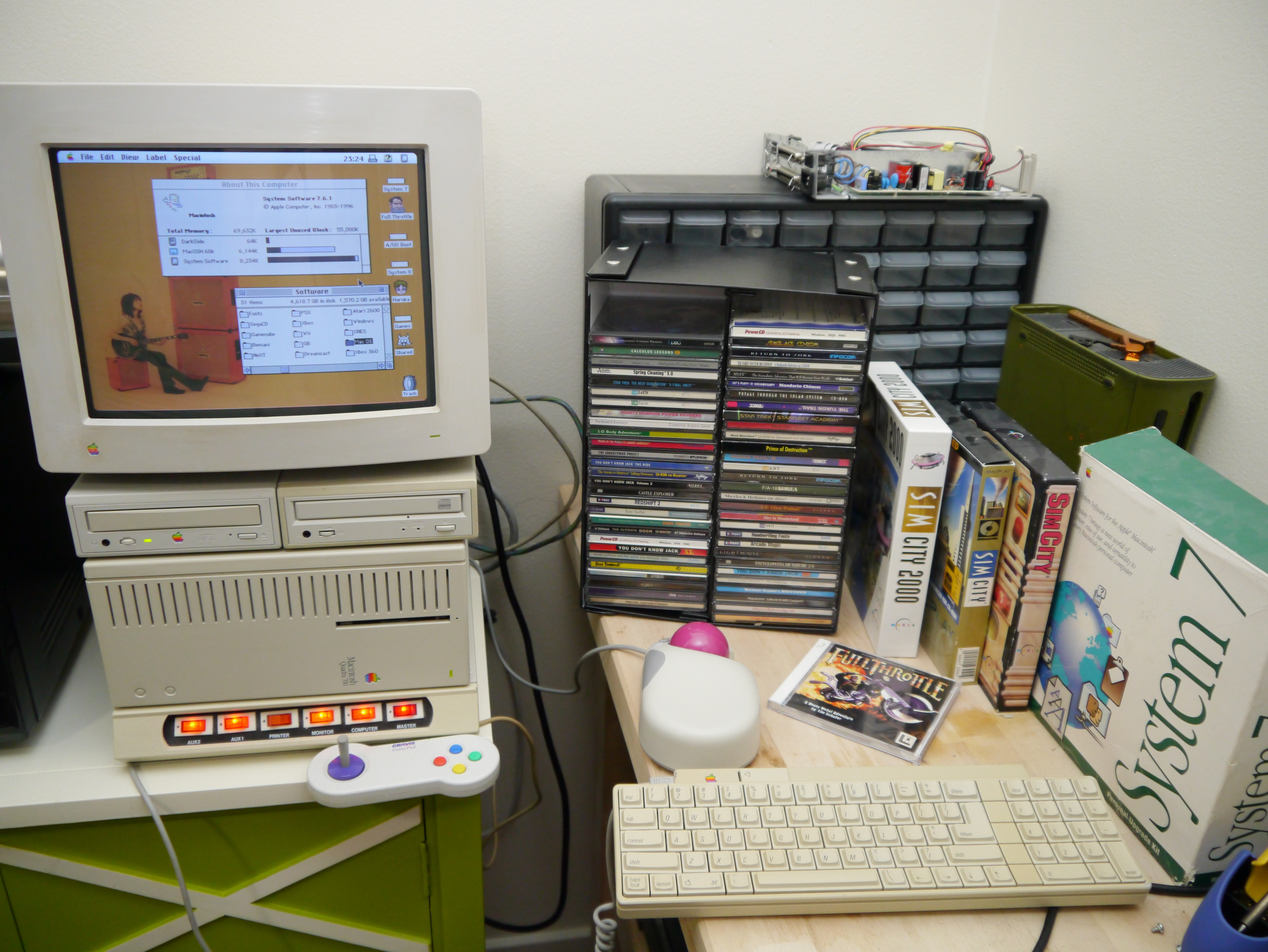
Oh man that's nice. When I was in high school slugging along with a Mac LC, I dreamt of having the amazing Quadra 700 with its superior speed and graphics. Crazy that the price was $5,700 ($14K in 2026) and you just picked it out of the trash.
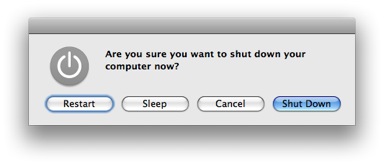
My memory from classic Mac OS is that pushing the keyboard soft-power key brought up a system-modal dialog asking if you wanted to shut down, restart, or cancel, a dialog with exactly the same design as: <http://www.christianboyce.com/page25/files/tipofthedayjulyth...>
That would obviously not be compatible with a server, maybe if soft power was just constantly held down starting from boot that dialog wouldn't show up?
It's a minor perk for sure. From their perspective, it probably costs essentially nothing, so why not.
But I can see it being useful if they're expanding to a nearby city. Waymo is in Los Angeles already and will expand into San Diego this year. If you live in LA, you might have friends, family, or business in San Diego and visit fairly often. Or maybe a group of people want to ride in one car for a weekend trip there but don't want to spend every moment together.
Because quicksort is like a worst case scenario for branch prediction.
Branch prediction works when the CPU can detect some kind of pattern in the program behavior, like if the branch usually goes one way and rarely goes the other way. If it predicts correctly, the CPU pipeline keeps going without stalling. If it predicts incorrectly, the CPU wastes time doing work that it has to throw away. Therefore, being able to predict correctly is essential.
In quicksort, you partition an array into two halves based on whether each element is smaller or larger than the pivot value. The key to good quicksort performance is to choose a good pivot which divides the values in half about equally. This means (assuming you're sorting randomly-ordered data) that the branching behavior will be totally unpredictable, like flipping a coin. So branch prediction will be basically useless.
Copying small chunks of data is OK if it all fits in cache, especially if it all fits in L1 cache. It's not ideal to copy data unnecessarily, but if it allows you to keep the CPU pipeline running at full speed with no stalls, it can be a good trade-off.
The symmetry is amusing. This is really fighting fire with fire.
Mosquitoes are a vector that spreads disease-causing germs to a population. The proposed solution is to use different mosquitoes as different vector that spreads a different disease-causing germ to a different population.
> raise sterile males and release them into wild insect populations. When a wild female mates with a sterile male, her eggs won’t hatch. The population gets smaller with each generation.
They won't harm then it sounds like, but they'll not fertilize the eggs.
OK, you bring up a very good point. If the eggs fail to hatch because they are never fertilized, then the mosquitoes are not acting as a vector because they do not transmit the disease. I didn't even consider that possibility.
That wikipedia article says that there are embryos, but the embryos die.
However, the real question to ask, I guess, is whether the embryo is infected. As I read that article, it sounds like it isn't. Instead, the male parent is infected and this creates sperm which can fertilize the egg but in a way that creates an embryo that can't survive. In other words, the male parent has an infectious disease which causes the embryo to have a fatal genetic disease.
So this also brings up another question: what exactly is a vector? In this scenario, the embryo has a disease it would not otherwise have gotten, if it weren't for this germ. However, the embryo doesn't have the germ itself. Is being a vector defined by whether some disease is caused, or is it defined by whether the germ is spread? I don't know.
Also, cleaning kitchens is a huge part of the job. Hotel rooms either have no kitchen or a very minimal one. You're not going to learn how to clean an oven or load a dishwasher in a hotel room. (And loading a dishwasher requires categorizing thousands of things as dishwasher safe or not! Stainless steel skillet, yes; cast iron skillet, no; etc.)
Maybe I'm weird, but I believe in the theory that (all else equal) it's good for business to minimize how much your users hate your product/service.
In other words, users dislike the feeling of not knowing whether things are ads. I can't see any real downside to labeling them, so you're better off doing it so you don't drive users away.
Have a rod that pivots in its center and has objects of equal mass at each end, like a balanced seesaw. But make one of the objects very low density (less than water) and other high density.
Since the densities differ, water will cause the rod to rotate. But since the masses are the same, bumps will create no net torque around the pivot point and thus no rotation.
ASCII art diagram:
    F------(x)------C

    (x): pivot point
    F: float
    C: counterbalance
Also include a small spring to keep the float in the down position.
I'm sure there are other ways like sensing the electrical resistance of the water.
Or just let the float sensor bounce. It's underwater when it stops bouncing and is continuously in the up position.
I surrender my speedometer ceremony for the wade sensor. Instead of a motor sweeping the speedometer from 0 to 200 on startup, put the motor to sweep the wade sensor.
Waymos are fleet vehicles. Recalls go to the owners, just like with other fleet vehicles such as rental cars, taxis, limos, delivery services, utilities, and city/state/federal government. It doesn't really matter who is whose customer.


Back in the 1990s, a Mac sysadmin showed me a clever trick for this.
Get one specific Apple Desktop Bus keyboard that has a soft power key on it, I believe the Apple Extended Keyboard[1]. Then get a Bic pen[2]. Push down the power key on the keyboard, and while it's still down, wedge the pen cap between the key and the keyboard case.
The pen cap is the perfect size and shape to hold the key down, and Bic pens are easy to find. There are no ill effects from having the power key down all the time, and the Mac will boot up after a power failure. So you don't have to drive to work just to push the power button.
This was especially handy considering you sometimes needed to use Macs as servers (file server, printing, certain Mac-only applications, etc.), but Apple did not make servers.
---
[1] https://en.wikipedia.org/wiki/Apple_Extended_Keyboard
[2] https://en.wikipedia.org/wiki/Bic_Cristal
reply