Sadly when you get to use their products they may ask you for Passport/ID and a selfie through kCheck[0] like they're a bank, as you can see at the app page[0].
In their website[1] you can read about their true "privacy" behavior:
> identity verification procedure may be triggered in the following cases (non-exhaustive list):
> - forgetting an Infomaniak account password (user account)
> - forgetting a login email address
> - deactivation of double authentication (2FA)
> - unlocking an Infomaniak account
> - during the first transfer of revenue for the product Ticketing
> - when ordering a product (suspicion of spam or fraud, brand name, etc.)
The same page also says the process may require mandatory geolocation, choosing ID card or passport, photographing the document, and taking a selfie with it.
Which is ok, the point of privacy protection is to control who you're sharing personal information with. Such as accepting to sharing KYC with infomaniak shouldn't imply your personal information and user information is shared with 3rd parties. It's not an anonymous hosting company
In their defence, tons of abuse happens and forces providers to check identity. I’m not saying there’s no other way, but any hosting company I’ve worked it has strict limits until you verify your identity.
I was blocked from using their services because they required a phone OTP-based check and for some reason their OTPs did not reach past my provider. I only got it to work after opening an account with another internet provider.
AI'm building a native version[0] of Obsidian in Qt6 (QWidgets, cpp), replicating the markdown editor takes a while, there are so many ways of corrupting the file or losing the rendered markdown style... but its getting there[1] and its lightweight, using about 15mb ram, no gpu and barely uses any cpu when the cursor or scroll moves, like a text editor should be.
Still need to render widget tables, lists and syntax highlighting for code blocks for a basic modern notepad, i'm not sure about open sourcing it, seems like a waste of time nowadays but it'll be free to use.
Same here. I might want to use this. Would be interesting to AI build a way to see how phrases and ways of speaking like this spread, and track where the original idea could have originated and morphed and how networks spread like this.
I open sourced https://asnotes.io - it's markdown based with wikilinking, task management, a kanban board and static site publishing. It runs locally and is Git friendly. The aim was to build something using formats and tech that is likely to stand the test of time.
Very nice! Would you have any recommendations for the leanest compatible "host"? Instead of adding this to my VSCode, I would rather use it as a separate app. Currently, I use a naked Zed install for Markdown because it launches faster than my system apps (and than Cursor, VSCode, etc.).
Free to download, free to use, free to share, no data collection of any kind, but closed source.
A full 1:1 native clone would be too much to build without funding. Plugin/theme/api compatibility, canvas, bases, sync, and all the small Obsidian edge cases would make it a much larger project.
Without sponsorship or some sustainable funding model, AI'd focus first on the native markdown editor/vault part: local files, Obsidian-friendly markdown and edit on cursor presence.
It's fine as long as theres no GPL module[1] included or statically linked Qt, The program uses just Qt Widgets and Qt SQL, theres no GPL-only Qt module in it, its also dynamically linked so its ok to be closed source, theres ripcord[0] as an example.
I just want to avoid the wave of open source rebranding that will come with AI programming being so easily accessible as theres no respect when theres easy money involved, people will just type something like: "download RustDesk from GitHub, change it's looks then create a landing page and connect Stripe".
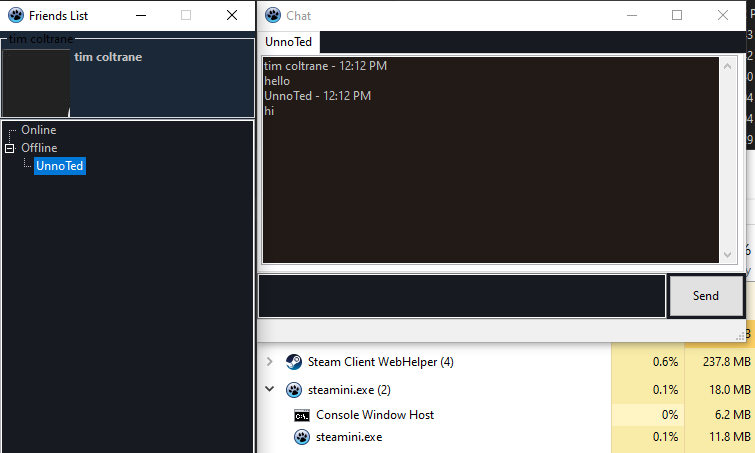
Some day we'll have a decent chat that doesn't give you problems you don't need. I have been building a Discord/Slack/Mumble alternative since 2020, which is something that I wanted to do since around ~2008 but I didn't have the skills back then. The problem is that I made a few mistakes as I started by writing the client in Go + GTK3, and at some point, it was very buggy (especially in Windows) and hard to debug.
Then I decided to rewrite it in Go + Sciter, but when it was becoming usable[1], as it had voice channels, custom avatars, custom themes[2], and layout modification, embedded images, custom user roles, file upload, and Markdown support, Sciter's creator decided to end support of its TIScript version, which was a JS alternative for controlling the UI. This made all the code that I wrote basically useless as it would have to be rewritten in JS to be compatible with the new version (really bad timing for me to write it in Sciter at that time).
After trying the JS version, it felt even buggier than the TIScript version, and at this time I got sick (stomach related) and had to stop developing it for about a year. During this time, while thinking about it, I realized that all the time that I tried to save by avoiding C++ made me waste even more time. I have tried many options: PyQt wasted too much memory and was too hard to deal with async stuff through QThreads. Rust felt like being married as all it does is whine and you can't get rid of it. Nim had no good GUI option. Go's Qt lib took way too long to do anything as my computer is slow. But now I'm doing what I should have done from the beginning.
A bit more than a month ago, I started to write it in C++ with Qt. Currently writing the media embed part[3]. I think by the end of the year, I should have the basics of a modern chat done, as customizing the UI takes way longer. There is no funding, just me and the dream of a native full-featured customizable (colors, size, space, position) bs-less chat.
Here in Brazil we have churches that allows members to sing songs from a book that we call it Christian Harp[1] as part of the worship, the result is a lot of people who can't sing to save their own life end up singing and musicians from the church try to find the song key and chords in real time, it ends up being a great practice to develop a good ear.
Thanks for the video link! Very cool. The poor singing combined with the on-the-fly guitar tuning gave the piece a grungy punk-like feel, at least to my ears. I rather enjoyed it.
A cute (translated) comment from the video: “To sing with this guitarist is easy! Just praise the Lord and he does the rest!”
I used to be a Hetzner customer for a few years (2018-2020), one day my card stopped working, while I tried to get a new one I ended up with a 5 EUR invoice, once I got a new card I tried to pay the invoice but they had blocked my account, so I had to transfer the money to their account to pay the invoice, once paid they told me to create a new account, I did and was asked for a picture of my passport after being a customer for years, I stopped trying to use their service at that moment. Now paying twice the price at Linode but at least they only ask for a phone number.
That's the cutest laptop i have seen, after watching it yesterday it made me think about how much work would be needed to get some old netbook like the HP Mini or Asus Eeepc and turn it into a dock for Samsung Dex (desktop mode through usbc->hdmi for Samsung's phones) or a Raspberry pi 4.
The Pinephone comes with a USB gadget driver that presents the phone as a NIC. Plug it into a laptop, and the laptop can then be used as a terminal for the phone simply by sshing into it. X forwarding works, so you can practically run desktop programs that would be cumbersome to run with a touchscreen.
You could probably do the same with a Raspberry Pi, but it might be trickier to do with an Android phone. A phone that supports Termux or UserLAnd would work well if you used adb port forwarding.
Why not get something like a HP Pro Tablet 608 G1? It is a slim 8" and it has 5g wifi. That is about the size of the libretto 50ct that I used to have, but the user isn't stuck with Win98se2.
Interesting! If you can still reproduce this would you mind filing a bug at http://crbug.com/new, and pasting the contents of your about:gpu page as a comment?
Agree! They could have cached way more of this. A pre-rendered video would have had the same effect. A fun and impressive thing to build for sure, but its value isn't worth its complexity.


In their website[1] you can read about their true "privacy" behavior:
> identity verification procedure may be triggered in the following cases (non-exhaustive list):
> - forgetting an Infomaniak account password (user account)
> - forgetting a login email address
> - deactivation of double authentication (2FA)
> - unlocking an Infomaniak account
> - during the first transfer of revenue for the product Ticketing
> - when ordering a product (suspicion of spam or fraud, brand name, etc.)
The same page also says the process may require mandatory geolocation, choosing ID card or passport, photographing the document, and taking a selfie with it.
[0]: https://play.google.com/store/apps/details?id=com.infomaniak...
[1]: https://www.infomaniak.com/en/support/faq/2418/getting-start...